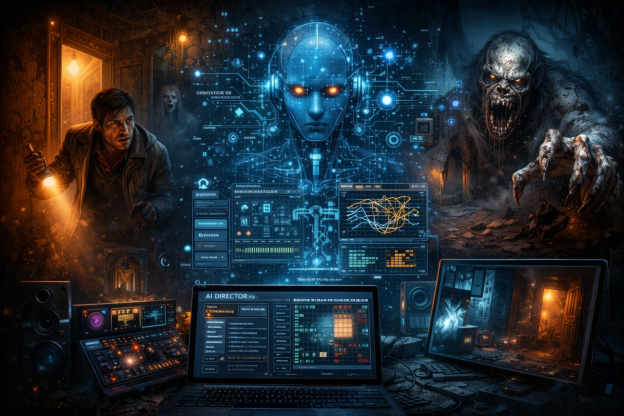
There is a law of diminishing returns in horror gaming. The first time a monster bursts through a window, you jump. The second time, you wince. By the third replay, you are already aiming your weapon at the window before the glass even shatters. Scripted scares are reliable, but they are finite. Once the player sees the strings, the puppet show is over.
This is the barrier that AI-driven dynamic storytelling promises to break. We are moving away from static scripts and logic trees toward systems that observe, learn, and adapt.
Game developers have toyed with this concept before. Alien: Isolation (2014) is frequently cited as the gold standard. Its Xenomorph wasn’t just patrolling a route; it was hunting. It used a dual-brain AI system, one that knew exactly where the player was (the Director) and one that only knew what it could see or hear (the Alien). The Director gave the Alien hints, creating the illusion of a predator with a sense of smell.
But with modern machine learning and generative AI for game development, we can go much further. We aren’t just building smarter enemies anymore. We are building environments that reshape themselves and narratives that rewrite their own tragic endings based on the player’s psychological state.
The Psychology of Adaptive Fear
Horror is an exercise in tension management. If the tension is too low, the player gets bored. If it stays at maximum intensity for too long, the player becomes desensitized or frustrated. To keep a player in the “flow state” of horror, the game needs to modulate terror in real-time.
To build adaptive horror games, your system must first understand what the player is feeling. Since we cannot plug a biometrics scanner into every player (yet), we rely on in-game behavioral telemetry.
An effective “Fear Engine” monitors specific inputs to gauge stress levels:
- Camera Hesitation: Is the player checking corners repeatedly? Are they refusing to enter a room? This suggests high anxiety/dread.
- Input Erraticism: Rapid, jagged camera movements often correlate with panic during encounters.
- Resource Hoarding: A player with full ammo who refuses to shoot is playing defensively out of fear.
By feeding these metrics into a central AI manager, the game can make decisions. If the player is confident and rushing through levels, the AI increases the atmospheric density and enemy aggression. If the player is paralyzed by fear, the AI might subtly lower the threat level to encourage them to move forward—only to ramp it back up once they feel safe.
Implementing Dynamic Storytelling with LLMs
The narrative structure of horror is traditionally rigid. You find a note, read a diary, or listen to an audio log. These are pre-written and static. However, dynamic storytelling powered by Large Language Models (LLMs) allows the lore to react to the player’s agency.
Imagine a scenario where the player chooses to sacrifice an NPC to save themselves. In a traditional game, this might trigger a specific cutscene. With procedural narrative integration, this choice can ripple through the entire game world textually.
Later in the game, when the player finds a diary entry from a survivor, the text isn’t a static asset. It is generated by an LLM that references the player’s previous action. The diary might describe the player not as a hero, but as a coward who left someone to die. This creates a psychological mirror, forcing the player to confront their morality in a way that pre-written text cannot.
Platforms like Astrocade are already enabling creators to experiment with these ideas, using AI agents to generate adaptive elements, choices, and narratives instantly—no coding required.
A prime example is The Silent One: Choices of Fate, a community-created psychological horror experience where player decisions dynamically shape the story, fate, and outcomes, turning every playthrough into a personal confrontation with consequences.
The Hallucination vs. Immersion Balance
The risk with AI in horror games, specifically LLMs, is hallucination. You do not want a 19th-century gothic ghost suddenly using modern slang or explaining the game’s code.
To implement this safely, developers must use strict system prompts and context constraints. The AI should act as a “fill-in-the-blanks” engine rather than a free-form writer. You provide the narrative beats; the AI provides the texture.
Mechanics of the “AI Director”
The “AI Director” is the invisible hand that controls the game’s pacing. In a generative horror game, the Director controls two main verticals: Enemy Behavior and Environmental Shifts.
Enemy Behavior: The Learning Adversary
For a game to remain terrifying, the enemy must feel intelligent. Standard behavior trees are predictable. Adaptive game difficulty requires enemies that learn from the player’s habits.
If a player constantly hides in lockers to evade detection, a standard AI will eventually just despawn and walk away. A machine-learning agent, however, will record this pattern. After three successful “locker hides,” the enemy AI updates its weights. The next time it enters a room, it doesn’t scan the open area; it rips the locker door off its hinges.
See this in action with Zombie Frontier on Astrocade, an AI-powered zombie survival shooter where waves of adaptive undead force you to constantly evolve tactics, keeping the tension high as enemies overwhelm defenses in unpredictable ways.
Here is a simplified logic flow for an adaptive enemy:
- Observation: Player avoids open combat and prefers stealth takedowns.
- Analysis: Stealth success rate is >80%. Tension metric is low.
- Adaptation: Enemy spawns now include “Scouts” that specifically watch flank routes and shadows.
- Execution: The player’s preferred strategy becomes the most dangerous one.
Environmental Shifts
Fear is often derived from a loss of control. Generative AI for games allows developers to manipulate the environment to gaslight the player.
Using procedural generation parameters linked to the “Fear Engine,” the level itself can change. If the player is backtracking through a hallway they have visited ten times, the AI can subtly alter the geometry. A door that was on the left is now on the right. A corridor is 20% longer than it was before.
Lighting is another powerful variable. If the player relies heavily on their flashlight, the AI Director can trigger a “battery failure” event or introduce enemies that are attracted to light, forcing the player to navigate in pitch darkness. This isn’t a scripted event; it’s a systemic reaction to the player’s reliance on a specific tool.
Challenges and Ethical Considerations
While the technology is exciting, building adaptive horror comes with significant design hurdles.
The “Impossible Game” Problem
An AI that perfectly learns a player’s patterns will eventually become unbeatable. If the enemy counters every move the player makes, the game ceases to be fun and becomes frustrating. The goal of the AI should not be to win; it should be to provide the most entertaining struggle. Developers must program “intentional flaws” or “relief windows” where the AI deliberately makes a mistake to give the player a fighting chance.
Narrative Coherence
Generative elements can break the suspension of disbelief if they contradict established lore. A procedural narrative system needs a “Lore Bible,” a database of immutable facts that the AI cannot alter. The generative content must exist within the boundaries of this truth.
Conclusion
We are standing on the precipice of a new era in horror gaming. We are moving from the “Haunted House” model, a static ride with animatronics jumping out at set intervals, to the “Psychological Mirror.”
By utilizing AI-Driven Dynamic Storytelling, developers can create deeply personal experiences. The game stops being a test of reflexes and starts being a test of the player’s psyche. It learns what you fear, and then it manifests it.
For developers looking to innovate, the time to start experimenting is now. You don’t need to build a sentient HAL 9000 to start. Begin by implementing basic machine learning models that track player movement or LLM integrations for dynamic flavor text. Platforms like Astrocade make this accessible today, heads up to astrocade to create or play AI-powered horror experiences instantly. The tools are available; the only limit is how brave you are willing to be.
Keep an eye for more latest news & updates on Tribune!