You don’t really notice electrical systems when they are working. That’s the funny part. Everything runs smoothly, switches respond instantly, machines do what they are supposed to, and no one thinks twice about it. But the moment something trips or fails? That’s when attention shifts. Usually, somewhere behind that issue, there’s a panel board involved.
Power isn’t just “there”. It has to be distributed properly. Controlled. Divided. Protected. Otherwise, even a small fault can spread faster than expected. That’s where a mini circuit breaker panel or larger power panel boards come into play. They sit quietly in the background, managing everything. Not flashy. Not complicated to look at. But absolutely essential.
Once you understand how electrical distribution panels work, you stop seeing them as just boxes and start seeing them as control systems.
What is a Panel Board
A panel board is, at its simplest, a place where electricity comes in and gets distributed. But that explanation feels incomplete. In reality, it’s doing a lot more than just splitting power.
Inside these electrical distribution panels, you will find breakers, busbars, and electrical connections arranged in a way that keeps the system organised and protected. More importantly, controlled. Think of it like traffic management.
Power flows into the panel, and the panel enables controlled distribution of electricity across different circuits while maintaining protection and isolation.
The last part matters.
If a fault occurs, the circuit breaker isolates the affected circuit while the remaining circuits continue operating normally. Without that, even a small issue could shut down an entire system. So yes, it distributes power. But more than that, it manages operational safety and fault control.
What is a Mini Circuit Breaker Panel Board
A mini circuit breaker panel is basically a panel that uses MCBs to manage and protect circuits. MCBs primarily provide protection against overload and short-circuit conditions within individual electrical circuits.
Each circuit inside the panel has its own breaker. That means each one can operate independently. So if one trips, the others don’t. That’s exactly what an MCB panel board is designed for- controlled distribution with built-in circuit protection.
You will see these panels used in homes, offices, and even parts of industrial setups where loads are moderate. They are popular for a reason. They are easy to install. Easy to maintain. When something goes wrong, troubleshooting usually starts directly at the affected breaker.
Sometimes, simple solutions really are the most effective.
Features of a Mini Circuit Breaker Panel Board
There is a reason these panels are everywhere. It’s not just about size or cost. It’s about practicality. They do exactly what’s needed, without unnecessary complexity. In electrical systems, that kind of simplicity often works better than over-engineering.
- Compact and Space-Efficient
A mini circuit breaker panel doesn’t take up much space, and that’s a big advantage. In smaller installations, every bit of space matters. But even with its compact design, it still handles multiple circuits effectively. This balance is important. You are not sacrificing functionality; you are just making it fit better into real-world spaces where panels can’t always be large or bulky.
- Individual Circuit Protection
Each circuit in an MCB panel board works independently. So when one trips, the rest continue running. This might sound obvious, but it makes a huge difference. Because instead of losing everything, you’re only dealing with one issue at a time. In practical terms, that means less disruption and easier troubleshooting.
- Easy Installation and Maintenance
These panels are straightforward. No complicated setup. A mini circuit breaker panel can be installed without extensive effort, and maintenance is just as simple. If something trips, you reset it. If something fails, you replace it. No major downtime. No complex intervention. This ease is what makes them so widely used.
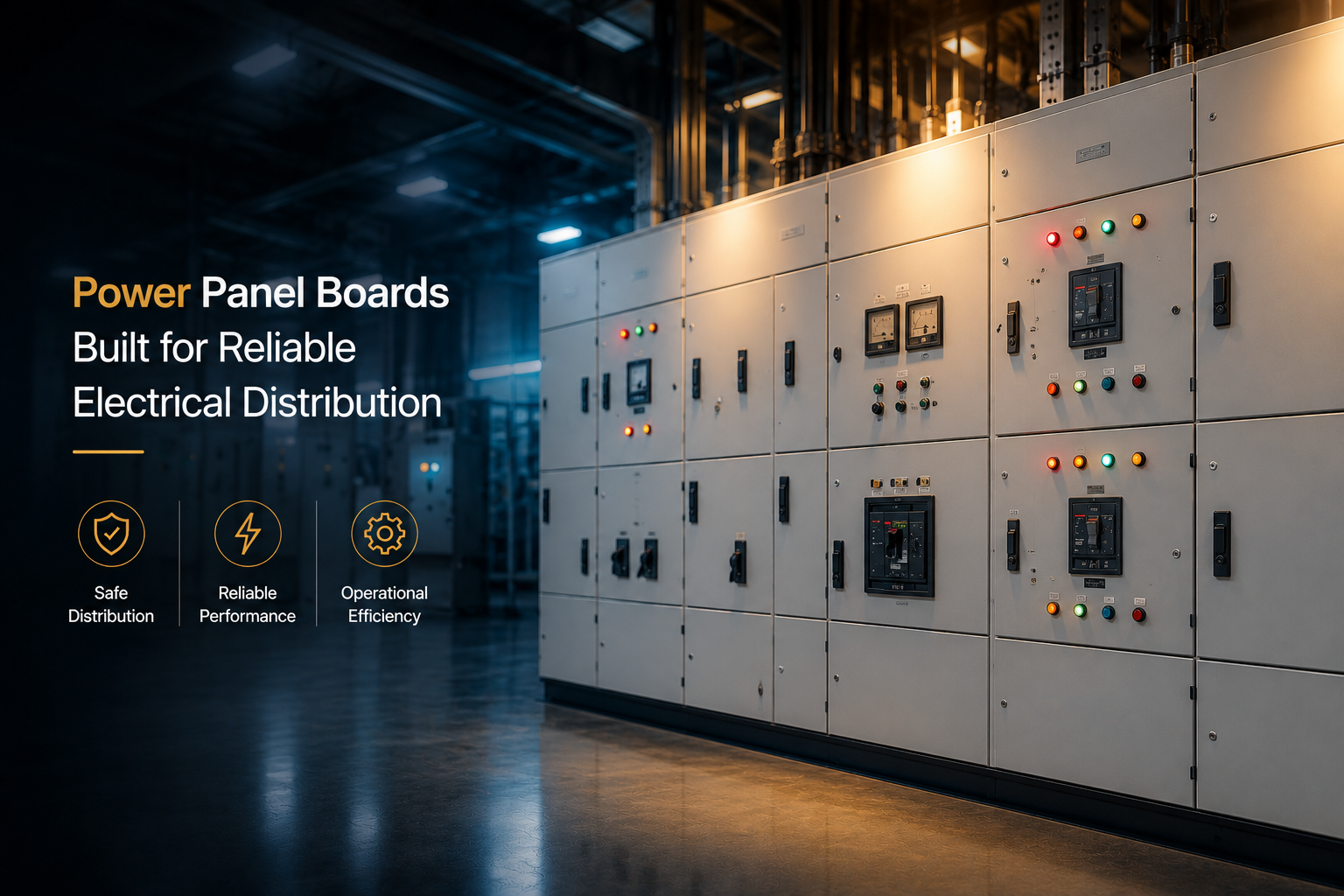
What is a Power Panel Board
Now, a power panel board is a different story. It’s built for bigger loads. Heavier demands. More responsibility.
Where a mini panel handles smaller circuits, this one deals with major power distribution involving machinery, motors, and industrial systems. Because of that, everything inside is designed differently.
Power panel boards typically use MCCBs or ACBs, along with higher-rated busbars and greater fault withstand capacity to handle demanding industrial loads safely.
In industrial setups, this panel often acts as the main control point. Power enters here first, gets managed, and then moves further into the system. But here’s the thing- when loads increase, risks increase too. So it’s not just about handling power. It’s about handling it safely. This is what makes these panels critical.
Features of a Power Panel Board
Power panels are built for demanding conditions. They don’t just distribute electricity. They handle stress. Continuous loads, heavy equipment, and long operating hours are all part of their environment. And their features reflect that reality.
- High Load Handling Capacity
A power panel board is designed to handle high electrical loads consistently. Industrial systems don’t operate in short bursts. They run continuously. This means the panel needs to keep up without overheating or failing. That’s where its design matters. It’s built to stay stable even under pressure.
- Advanced Protection Mechanisms
At higher loads, protection becomes critical. Power panel boards commonly include protection against overload, short circuit, and earth faults, often through MCCBs, ACBs, or protective relays depending on system requirements. This protects both the equipment and the wider electrical system. In industrial environments, delayed fault isolation can result in serious equipment damage and operational downtime.
- Scalable and Customisable Design
A power panel board isn’t always fixed. It can be designed based on specific needs- more circuits, higher capacity, different layouts. As systems grow, the panel can adapt. The flexibility makes it suitable for long-term use, especially in setups that evolve over time.
Role of Panel Boards in Electrical Systems
When you look at the system as a whole, panel boards aren’t just components. They are organisers. They structure how power flows, how faults are handled, and how everything stays under control. Without them, electrical systems would be unpredictable and much harder to manage.
- Role of Mini Circuit Breaker Panel Board
A mini circuit breaker panel handles smaller, local distribution. It ensures circuits operate safely and independently. When something goes wrong, it isolates the issue quickly. This makes it the first level of control in many systems. Small, but important.
- Role of Power Panel Board
A power panel board works at a higher level. It manages larger loads and distributes power across major sections. In industrial setups, it’s often the central control point. Together with smaller panels, it creates a structured system that’s both reliable and efficient.
Conclusion
Panel boards don’t usually get attention. They just sit there, doing their job quietly. But if you remove them or choose the wrong ones, you will notice the difference immediately. From a mini circuit breaker panel handling everyday circuits to power panel boards managing heavy loads, each plays a role that’s hard to replace. When they work together, the entire system becomes stable, predictable, and easier to manage.Lauritz Knudsen Electrical & Automation design solutions that reflect this balance- practical, reliable, and built for real-world conditions.