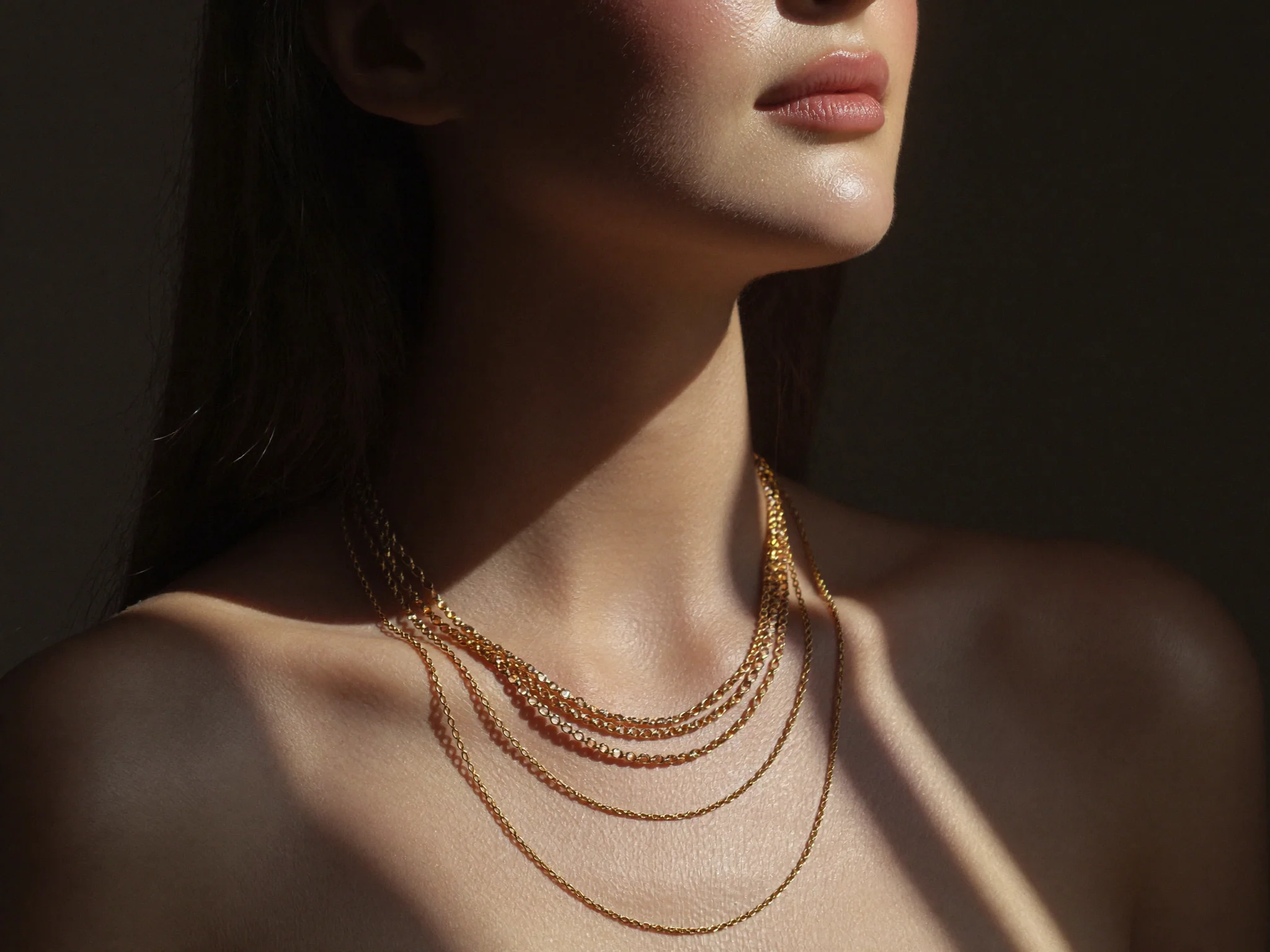
So you want the best gold jewelry for sensitive skin: pieces that don’t itch, leave a green line, or keep you up at night. If “hypoallergenic” has burned you before, you’re not imagining it, and you’re not stuck with plain basics. The fix isn’t a marketing badge; it’s a short list of things you can actually verify. And the list starts with 14k gold jewelry and a nickel-free alloy. Here’s how to read the difference, dodge the traps, and buy with confidence.
Best Gold Jewelry for Sensitive Skin: Start With Why It Reacts
Is gold jewelry good for sensitive skin? Yes. Solid gold with a nickel-free alloy is one of the best choices for sensitive skin. Pure gold barely reacts; the real trouble is what’s mixed in or layered over it. Most irritation traces back to alloy metals (nickel is the usual offender), copper or brass turning skin green, or a thin plated coating wearing down to the cheap base metal underneath.
Add sweat, lotion, and buildup trapped against the metal, plus pressure from tight rings or heavy pieces, and “sensitive skin” has a clear lineup of suspects.
Here’s the reframe: your skin isn’t impossible. It’s specific. Once you spot the culprit, you can rule things out. If a reaction lingers across several pieces, a dermatologist’s patch test names the exact metal. And “hypoallergenic”? It means lower risk, not a guarantee.
Which Solid Gold Is Safest for Reactive Skin?
The safest choice isn’t simply “gold.” It’s solid gold with a known, nickel-free alloy and no plating against your skin. That’s the whole game. Solid 14K gold is the everyday standard for exactly this reason: it’s real gold all the way through, alloyed without nickel by choice, not by chance. Nothing flakes off, nothing wears down to a mystery metal.
Is 14K or 18K gold better for sensitive skin? Both are kind to skin when the alloy is nickel-free. The real difference is durability and cost, not safety. Here’s how the common karats compare, from soft, pure 24K down to alloy-heavy 10K:
| Karat | Gold content | Sensitive-skin note |
| 24K | ~99.9% | Purest, but too soft for secure everyday settings |
| 22K | ~91.7% | Skin-kind, but delicate for many modern designs |
| 18K | ~75% | More gold, less alloy; a beautiful, slightly softer choice |
| 14K | ~58.3% | The everyday standard: durable, wearable, cost-smart |
| 10K | ~41.7% | More alloy means a higher chance of bothering reactive skin |
Color counts too. Yellow gold is the simplest pick. White gold needs a second look: some formulas use nickel, so palladium-based white gold is safer. Rose gold gets its blush from copper, which can irritate. And sensitive skin doesn’t doom you to plain basics. Solid gold still does bezel settings and curated stacks. Think cost-per-wear: a solid gold huggie worn daily for years out-values the plated one you replace twice a season. The flat back gold stud earrings and 14k gold huggie earrings you can sleep in are a good place to start.
What Jewelry Should Sensitive Skin Avoid?
If the metal touching your skin is unknown, coated, or alloyed without disclosure, treat it as a risk. The usual offenders:
- Gold-plated pieces: fine for a while, then irritating once the thin coating wears down to the base metal. Daily wear, showers, sleep, and sweat speed that up.
- Gold-filled jewelry: better than plating, but still a base-metal core under a gold layer.
- Nickel, brass, and copper-heavy pieces: classic reactive metals, common in cheap fashion jewelry.
- Low-karat gold with undisclosed alloys: “gold” tells you nothing if no one says what else is in there.
- Vague “hypoallergenic” or “tarnish-free” claims with no proof: a label is a starting point, not evidence.
None of this should make you anxious. It makes you sharp. Which brings us to the part nobody teaches you.
How Can You Tell If Gold Jewelry Is Nickel-Free or Truly Solid Gold?
You check the listing before you buy. A skin-friendly purchase is made before the package arrives. A good listing tells you exactly what touches your skin and what it’s made of. Run through this:
- Is it solid gold, gold-filled, vermeil, or plated?
- What karat is it, and is there a hallmark (14K, 18K, 585, 750)?
- Is the alloy explicitly nickel-free?
- What are the posts, backs, clasps, and chain made of, and are they the same metal as the front?
- Is the finish smooth and low-profile where it meets skin?
- Are returns or exchanges clear if it doesn’t work out?
If a page can’t answer those, the silence is your answer. The best listings put it up front: solid 14K gold, a nickel-free alloy, and matching post-and-back materials. Those are the hypoallergenic gold jewelry details you’d otherwise have to email for. Still unsure? Ask the jeweler what’s in the alloy, whether the white gold is palladium-based, and if you can wear it daily.
Living With Sensitive Skin: Everyday Wear and Care
The right piece does most of the work; habits handle the rest. Wipe sweat, lotion, and sunscreen off skin and jewelry, clean with mild soap and water when needed, and dry fully. Store pieces separately, and give irritated skin a break before layering back on.
The good news with solid gold: you don’t have to baby it. A solid 14K piece is built to be lived in: sleep, shower, sweat, repeat. If your skin flares, take the piece off, let it settle, and patch-test across metals if reactions persist. For piercings that stay touchy even after healing, some people explore implant-grade titanium, but solid 14K nickel-free gold is biocompatible and made to be worn from day one, with nothing working against you. Low-profile flat back earrings especially spare you the poking and pressure that bother sensitive piercings.
Sensitive skin doesn’t mean quiet disappointment. It means buying on proof, not promises: solid gold, a nickel-free alloy, a smooth finish, and a listing honest enough to say so. Get those right and the daily decision disappears. You just get dressed. Look for solid 14K gold, designed to be worn, slept in, and kept.
Frequently Asked Questions
Why does my gold jewelry turn my skin green? Usually it’s copper in the alloy or a plated piece wearing down to its base metal. Solid, nickel-free 14K gold has no coating to lose, so it won’t leave that green line behind.
Can I wear solid gold jewelry in the shower or the pool? Yes. Solid 14K gold won’t tarnish or react with water, chlorine, or sweat. There’s no need to take it off: shower, swim, work out, and sleep in it.
Can I get a fresh piercing with solid gold jewelry? Absolutely. Solid 14K nickel-free gold is biocompatible, so nothing in the metal works against healing. It’s made to start with, not just switch to once you’ve healed.
Is “hypoallergenic” jewelry always safe for sensitive skin? Not necessarily. “Hypoallergenic” means lower risk, not zero. Check for solid gold, a stated nickel-free alloy, and what the posts and backs are actually made of.