A basement window well is a small excavation with an outsized job: it lets daylight and fresh air reach a window below ground level. Left uncovered, it becomes a catch basin for rain, leaves, and melting snow, and the window that was supposed to brighten the basement turns into the room’s weakest point for leaks. A well-chosen cover reverses that trade-off, shedding rain and debris while still letting sunlight through.
The short answer is this: for most homes, a clear polycarbonate cover that fits the well tightly and slopes away from the house gives the best balance of rain protection and natural light. Metal grates win where fall protection or security matters more than brightness, and mesh covers suit homes that need ventilation more than a watertight seal. The right choice depends on the shape of your well, whether the window is an emergency escape route, and how much rain and snow your climate delivers.
What a Basement Window Well Cover Actually Does in Rain and Sunlight
A window well cover is a rigid shield that sits over the top of the well, spanning from the foundation wall to the surrounding grade. Its first job is to intercept water before it reaches the window: rain that would fall straight into the well hits the cover and runs off to the sides. Its second job is to block the debris that causes most well problems: leaves, twigs, and soil that wash in, clog the well drain, and hold moisture against the frame.
How rain reaches a below-grade window
Water reaches a basement window through three routes, and a cover addresses only the first two directly. Direct rainfall drops into an open well and pools at the bottom, pressing against the frame and finding any failed seal. Surface runoff from a sloped yard or a roof valley can pour over the well’s edge during heavy storms. Groundwater pushing up from below is the third route, and no cover can stop it. So a cover is excellent protection against rain and runoff, but water rising through the well floor or seeping through the foundation points to a drainage or waterproofing problem, not a cover problem.
Clear Polycarbonate Domes Versus Steel Grates for a Basement Well
The two dominant cover families solve different problems, and choosing between them is the single most important decision in this project. Clear polymer covers prioritize weather sealing and light. Metal grates prioritize strength, ventilation, and fall protection. Neither is universally better; the winner depends on what your basement needs most.
When a bubble cover earns its height above grade
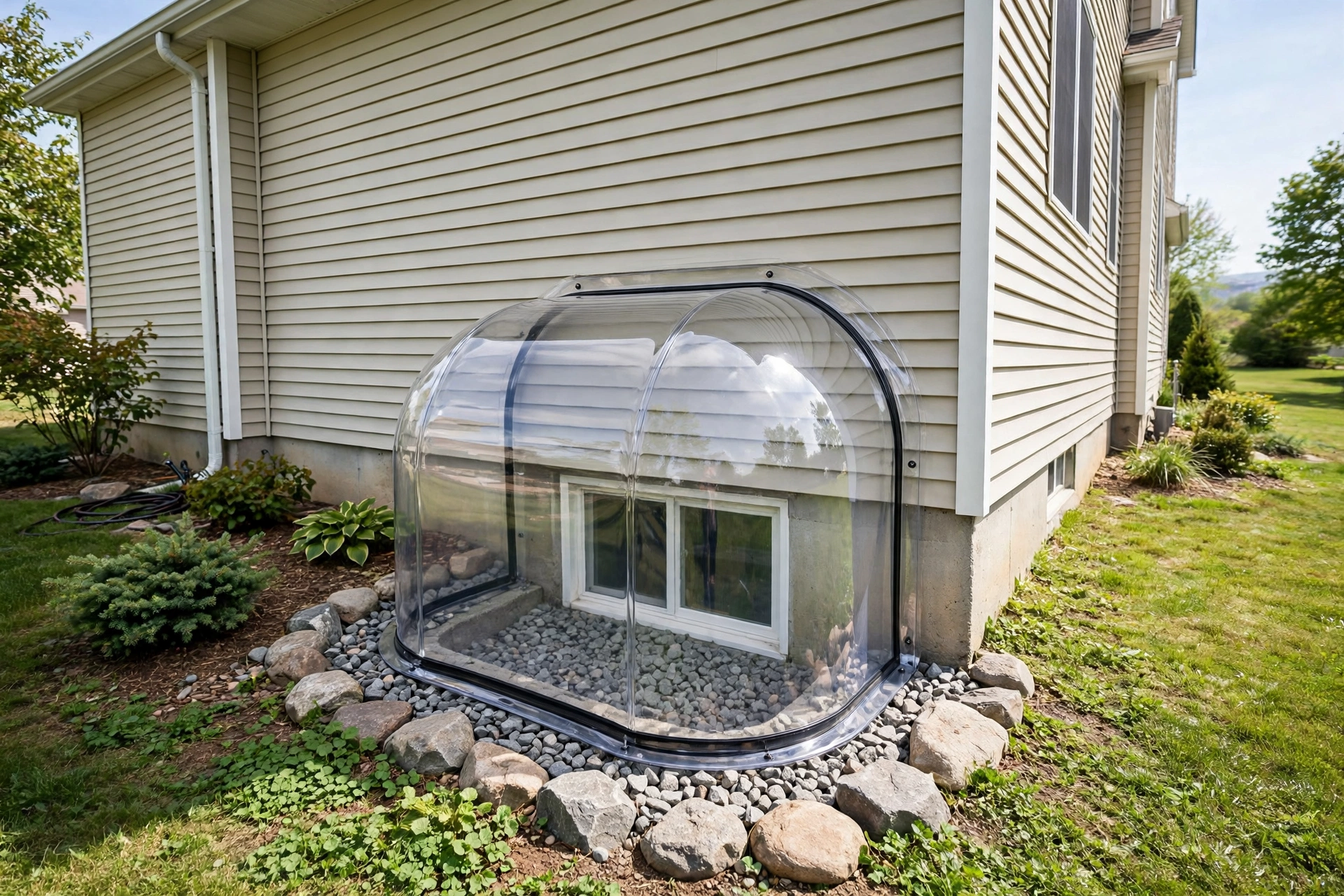
Bubble or dome covers are raised, curved shells, usually polycarbonate, that arch over the well. Their curved profile sheds rain and snow efficiently, and the height accommodates windows that project above the top of the well, which flat covers cannot do. They are the strongest choice for wet climates and wells that collect drifting snow. The trade-offs are visibility, since a dome is more noticeable from the yard, and price, since custom domes cost more than flat stock covers.
When a steel grate is the safer call
Steel and aluminum grates are open-grid covers that let air and some water pass through while blocking people, pets, and large debris from falling in. They carry heavy loads, resist impact, and are difficult to remove from outside, making them the standard choice where a well sits in a walkway or a play area. Their weakness is exactly what makes them strong: the open grid admits rain, so a grate alone will not keep a well dry. Many homeowners pair a grate with a clear cover beneath it, or accept that the grate’s job is safety and ventilation while the well drain handles water.
Matching the Cover Shape to Your Well: Flat, Sloped, and Bubble Profiles
Cover shape follows well geometry more than personal taste. Flat covers sit level with the ground and suit shallow wells where the sill is at or below grade, but they need a slight pitch or rain will sit on the surface. Sloped covers angle away from the house and are the practical middle ground, shedding water like a dome while keeping a lower profile. Bubble covers are required when the window rises above the well’s rim or when snow loads are heavy. Before ordering, note whether your well is rectangular, round, or irregular, and whether its rim is level or stepped. Wells that do not match a stock size need a custom cover.
Sizing a Window Well Cover So Rain Runs Off, Not In
A cover that is even slightly undersized is worse than no cover at all, because it funnels water into the gaps and hides the resulting damage. Measure twice, in three dimensions, before you order.
- Measure the width across the front of the well, from one inside edge to the other, at the widest point.
- Measure the projection, the distance the well extends outward from the foundation wall to its outer rim.
- Measure the height from the ground or rim to the top of the window, which determines whether a flat cover can work or a dome is required.
- Note the well’s shape, including any curves, corners, or stepped sections, and photograph it from above for a custom order.
- Check that the cover will overlap the rim by at least an inch on every side, so wind-driven rain cannot slip under the edge.
If your measurements fall between stock sizes, order the larger size or go custom rather than trimming a cover down, which can weaken a dome and void its warranty. Also confirm the cover weight rating suits its location: a lawn cover needs far less strength than one beside a driveway or a path where children play.
Fitting a Window Well Cover Without Trapping Water Against the House
Installation is usually a straightforward do-it-yourself job for a standard rectangular well, but the details decide whether the cover helps or hurts. Start by clearing the well completely and checking the drain at its base. A clogged well drain under a new cover will still flood; it will simply flood out of sight. Clear leaves and silt, flush the drain with a hose, and confirm water actually leaves the well rather than pooling.
Set the cover so its high edge sits against the foundation wall and its slope runs away from the house, directing runoff onto the surrounding grade. Fasten it with the clips or anchors supplied by the manufacturer, but do not seal the wall-side joint with caulk on an egress well, since the cover must remain removable from inside. Leave the small ventilation gaps the design provides: a fully sealed cover can trap humidity against the window and encourage condensation on the frame. After the first heavy rain, inspect the well. A dry floor and a clean window confirm the fit; standing water means the cover is pitched the wrong way, the rim overlap is insufficient, or the well drain needs attention. Clear leaves each autumn and wash clear panels each spring.
Keeping an Egress Well Escapable Under Its New Cover
This section is safety-critical, and it overrides every other consideration when the basement window serves a bedroom or another sleeping space. Building codes in the United States and Canada generally allow a cover over an egress well, but only on one condition: a person inside must be able to open or remove the cover from inside the well without a key, a tool, or special knowledge, and without reducing the well’s required clear opening. A bolted, padlocked, or screwed-down cover over an egress window is a code violation even if the window itself is fully compliant, and it can fail an inspection and endanger occupants in a fire.
Well dimensions matter here too. Under the International Residential Code, an egress well needs a minimum horizontal area of 9 square feet, with both the projection and the width at least 36 inches, and a permanently fixed ladder or steps when the well is deeper than 44 inches. Local codes vary, so verify the rules that apply in your municipality before buying. If you are unsure whether a window counts as egress, treat it as egress and choose a cover with an internal release.
What a Window Well Cover Costs, and What Pushes the Price Up
Prices vary widely with material, size, and customization, so treat every figure below as an estimate for planning, not a quoted price. Stock covers for standard wells are the most affordable route, while custom fabrication for oversized or irregular wells is where costs climb. Professional installation adds to the total, especially when the well needs drainage repairs first, and that repair is often the more valuable spend.
A realistic total budget is a few hundred dollars per well for a good stock cover, plus installation if you hire it out. Compared with the cost of repeated water damage to a window frame, drywall, and flooring, the cover usually pays for itself the first time it prevents a flooded well.
Rain Still Pooling After the Cover? The Drainage Problem Hiding Underneath
If water still collects in a covered well after every rain, the cover is probably not the culprit. First, check the well drain for clogs, since silt and roots block it silently. Second, look at the grading and downspouts: a downspout that discharges beside the well, or soil that slopes toward the foundation, will overwhelm any cover. Third, consider the water table and foundation condition; persistent seepage through the wall or floor of the well points to a waterproofing issue that needs a professional assessment.
Final Call: Picking the Right Window Well Cover for a Brighter, Drier Basement
For a basement that needs both rain protection and natural light, start with a clear polycarbonate cover shaped to your well, sloped away from the house, and fitted with an overlap on every side. Add a steel grate above it only if the well sits where someone could fall in or where security is a genuine concern. Respect the egress rule without exception if the window is an escape route, and fix the well drain before you spend money on the cover itself.
Window Well Cover Questions Basement Owners Keep Asking
Will a window well cover make my basement darker?
A clear polycarbonate or acrylic cover has only a small effect on daylight, with manufacturers reporting light transmission around 90 percent for quality polycarbonate. A metal grate shades more, and a dirty clear panel dims light more than the material ever will. If brightness is your priority, choose clear material and wash it each spring and autumn.
Can I legally cover an egress window well?
Yes, in most jurisdictions, provided the cover can be opened or removed from inside the well without a key, a tool, or special knowledge, and it does not reduce the well’s required clear opening. Locked, bolted, or screwed-down covers over egress wells fail inspection. Verify your local code before installation, since exact dimensions and ladder rules vary.
How do I measure a window well for a cover?
Measure the width across the front, the projection from the foundation wall to the outer rim, and the height from the rim to the top of the window, then note the well’s shape. Order custom if the well does not match a stock size, and make sure the cover overlaps the rim on every side so wind-driven rain cannot slip underneath.
Will a cover stop all water from entering my basement window?
A well-fitted cover stops direct rainfall and most surface runoff from entering the well, which solves the majority of wet-well problems. It cannot stop groundwater rising from below or water seeping through a failed foundation seal. If water persists after covering the well, inspect the well drain, the grading, and the downspouts before assuming the cover has failed.
How often should I clean and inspect a window well cover?
Inspect the cover and well at least twice a year, in spring and autumn, and after major storms. Clear debris from the top of the cover, wash clear panels, check clips and anchors, and confirm the well drain is open. This short routine prevents the two most common failures: a clogged drain hidden under a cover, and a panel clouded by grime that quietly darkens the basement.