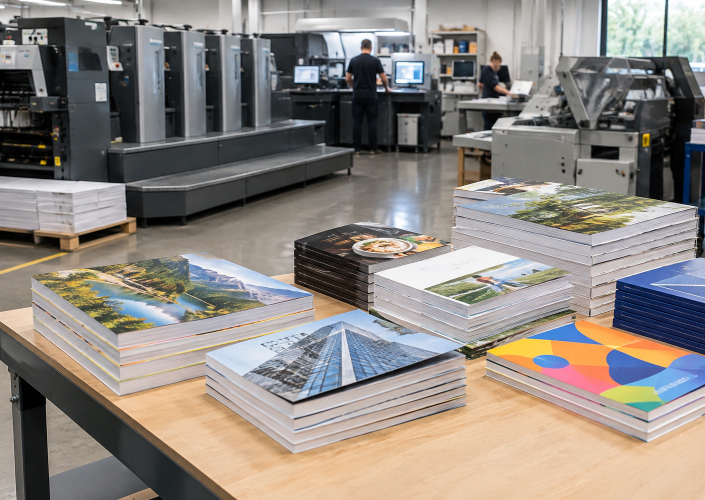
When a project needs the polished look of a paperback without the expense and production approach of a hardcover, perfect binding can be a practical solution. It gives books, manuals, catalogs, reports, and presentations a square spine and a professional softcover format that is easy to distribute, display, and store.
Printivity helps customers move from completed content to finished perfect bound books by providing online product options, templates, file-upload tools, production guidance, and assistance with artwork preparation. The result is a more manageable process for authors, businesses, schools, nonprofits, and organizations that need a professional printed publication.
Why Choose Printivity for Perfect Bound Books?
A perfect bound book request can involve many decisions, including page count, paper stock, cover treatment, spine artwork, delivery timing, and file setup. Printivity simplifies those choices by offering a guided ordering process and book-specific production options. Customers can select a size, quantity, interior printing approach, paper, and cover finish based on how the finished piece will be used.
Perfect binding gathers interior pages and secures them with adhesive along one edge, then wraps them in a cover that forms a flat spine. This creates the familiar appearance of a paperback book. It is especially useful when a document needs more permanence and shelf presence than a stapled booklet but does not require a rigid casebound cover.
Print remains relevant for organizations and publishers that need a physical format for reading, training, sales, events, or distribution. The publishing industry data collected from more than 1,300 U.S. publishers and distributors by the Association of American Publishers also reflects the continuing importance of measuring book and publishing activity across formats.
Projects That Work Well With Perfect Binding
Perfect bound books are versatile because they balance a polished appearance with straightforward softcover construction. They can support text-heavy publications, image-led pieces, or a combination of both.
· Self-published novels, memoirs, and short books.
· Annual reports, business reports, and client presentations.
· Training manuals, course materials, and educational guides.
· Product catalogs, lookbooks, and company portfolios.
· Magazines, editorial publications, and event programs.
· School, nonprofit, and community publications.
· Professional documents that need a clean, shelf-ready format.
How the Perfect Binding Process Works
1. Define the project. Establish the finished size, orientation, page count, quantity, paper preference, cover finish, and desired delivery date.
2. Prepare the files. Build the interior and cover files using the correct trim dimensions, bleed, safety margins, and spine measurements.
3. Upload artwork. Submit the book files through the ordering workflow and review the product selections before checkout.
4. Review prepress details. Check the proof or file-review feedback carefully for page order, cover placement, margins, and spine alignment.
5. Approve production. Once the files and specifications are confirmed, the order can move into printing and binding.
6. Receive the finished books. Delivery timing varies with page count, quantity, selected options, and shipping destination.
Page Count, Paper, and Binding Strength
How Page Count Affects the Spine
The spine is not a fixed measurement. Its width changes with the number of pages and the thickness of the chosen paper. A thicker interior stock creates a wider spine, while a lower page count or lighter stock may leave little room for spine text. Printivity notes that spine customization depends on having sufficient width, and narrow spines may not accommodate readable artwork.
Standard perfect binding is generally suited to Printivity projects from about 30 to 200 pages. For longer or frequently handled books, customers should consider PUR perfect binding. PUR adhesive is intended to provide greater flexibility and durability than traditional EVA adhesive, making it a useful option for substantial manuals, catalogs, and books that will see repeated use.
Why Paper Selection Matters
Paper influences more than appearance. It affects the book’s thickness, weight, opacity, handling, and spine calculation. Coated paper can be a natural choice for catalogs, image-heavy portfolios, and full-color pieces. Uncoated paper may be better suited to novels, workbooks, reports, and manuals where a less reflective surface or easy writing is useful.
How to Avoid Common Perfect Bound Book Errors
Careful prepress preparation can prevent many common problems. Keep important text and graphics away from the trim edge and binding area. Confirm that images are high enough resolution for print, review page order, and ensure that blank pages are intentional. If the cover includes a spine, wait until page count and paper selections are final before locking in its dimensions.
Color and image quality should also be reviewed as part of the complete product, not as isolated technical details. A study evaluating print-on-demand books found that overall book quality depends on more than a single technical measurement. That is why proofing, paper selection, cover design, binding, and content review all matter together.
Perfect Binding Compared With Other Options
· Perfect binding: Best for paperback books, catalogs, reports, magazines, and manuals that need a square spine and traditional book appearance.
· PUR perfect binding: Best for projects that need stronger, more flexible adhesive performance or will be handled often.
· Saddle stitching: Best for shorter booklets and programs. It uses staples along the fold and is generally better for lower page counts.
· Spiral binding: Best for workbooks and reference materials that need to lie flat or turn back on themselves.
· Hardcover binding: Best for premium, archival, or gift-oriented projects that justify a more substantial construction.
What to Include in a Perfect Bound Books Request
· Final interior page count and finished trim size.
· Portrait or landscape orientation.
· Interior paper preference and color requirements.
· Cover stock, coating, and finish preference.
· Binding choice, including whether PUR is needed.
· Quantity, delivery deadline, and shipping destination.
· Print-ready interior and cover files, or a request for design support.
· Spine text, if applicable, after spine width is confirmed.
Design Support and Final Review
Customers without a fully prepared cover or layout can benefit from design assistance. Support may help with cover composition, spine construction, visual hierarchy, and production-ready file setup. However, the customer should still make the final review of names, dates, page order, copy, and factual content before approving a proof.
Conclusion
A successful perfect bound book begins with clear specifications and ends with careful proof review. Printivity provides a practical path for customers who need professional softcover books, manuals, catalogs, reports, or presentations. By selecting the right binding, paper, cover treatment, and spine design before production, customers can create a finished piece that looks intentional, reads comfortably, and is ready to share.