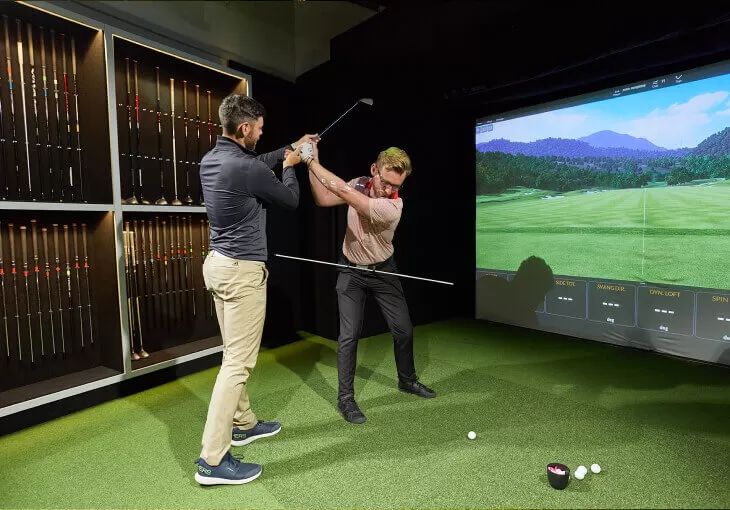
For decades, improving your golf game meant hours at the driving range, unpredictable weather conditions, and guesswork about what was actually going wrong in your swing. Today, technology has changed the game , quite literally. With high-speed cameras, precision tracking systems, and instant feedback, simulator-based golf instruction has redefined how players learn and refine their technique. Through indoor golf lessons Toronto, golfers can now train smarter, practice consistently, and see measurable improvement without ever setting foot on a traditional course.
Golf simulator lessons combine the best of both worlds: the data-driven insight of modern sports technology and the personal, intuitive guidance of traditional coaching. They help players understand their swing from the inside out, revealing what’s really happening in each shot , not just what it feels like.
In this article, we’ll explore how simulator technology turns ordinary practice sessions into science-backed, results-driven lessons. Whether you’re a new golfer trying to build solid fundamentals or a seasoned player chasing precision, these lessons can help transform how you think, move, and perform.
1. The Science Behind Golf Simulators: More Than Just a Screen
At first glance, a golf simulator looks like a blend of video game and practice bay , a screen, a mat, and a projector. But under the surface, the technology is surprisingly complex.
How It Works
Modern golf simulators use a combination of radar systems, high-speed cameras, infrared sensors, and sophisticated software to track what happens from the moment the club strikes the ball to the second it “lands” on the virtual fairway.
The system collects hundreds of data points in real time, measuring details like:
- Club path: The direction your club travels through impact.
- Face angle: Whether your clubface is open, square, or closed at contact.
- Launch angle: The initial trajectory of the ball.
- Spin rate: The amount of backspin or sidespin, affecting flight and roll.
- Ball speed and carry distance: How far and how fast your shot really goes.
In a traditional practice session, you might guess what caused a slice or a hook. With simulator technology, the guesswork disappears. You see the numbers instantly, allowing you and your instructor to pinpoint the problem , and fix it on the spot.
Why This Matters for Learning
The biggest advantage of this data-rich approach is feedback. Golfers learn fastest when they understand why something happens. Simulators provide that cause-and-effect relationship clearly.
You’re not just swinging harder or aiming differently because your instructor says so; you’re doing it because the numbers show you the direct outcome of each adjustment. This creates a faster, more sustainable learning process.
2. Seeing Is Believing: Real-Time Feedback That Changes How You Learn
In traditional golf instruction, much of what happens is based on feel. You’re told to “keep your head down” or “rotate your hips more,” but translating those cues into consistent movement can be difficult. The simulator changes that by letting you see your performance , instantly.
The Power of Instant Feedback
Every swing is captured from multiple angles, allowing players to view their mechanics in slow motion. You can analyze your grip, stance, tempo, and impact frame by frame. This visual feedback bridges the gap between feeling and reality , showing you exactly where your movement differs from what you think it is.
For example, a player might feel like their clubface is square at impact, but the camera reveals it’s slightly open, causing a fade. Correcting that small detail becomes much easier when you can see it, not just imagine it.
Personalized Data Means Personalized Coaching
Simulators also make it possible for instructors to tailor lessons more precisely. Instead of generic swing advice, coaches can base their guidance on measurable results.
A good instructor can interpret your launch data and video footage to identify your unique swing tendencies. Maybe your path is solid, but your launch angle is too high. Or perhaps your timing is great, but your tempo varies under pressure. The simulator gives them the evidence they need to build a lesson plan that targets the real issue.
Motivation Through Measurable Progress
Seeing quantifiable progress is one of the most motivating aspects of simulator training. When you can look back and compare your spin rates or accuracy from week to week, improvement feels tangible.
This turns practice from routine repetition into an engaging process of discovery. You’re not just hitting balls , you’re uncovering patterns, testing theories, and building confidence with every session.
3. Breaking Down the Swing: How Technology Builds Better Mechanics
While simulators are impressive in their data collection, their real strength lies in how they help players improve biomechanics, the physical side of the swing.
Identifying Flaws Early
Even small mechanical flaws can create big performance issues. A slightly over-the-top swing path, an unstable lower body, or inconsistent wrist hinge might not be obvious to the naked eye, but simulators pick them up immediately.
Once identified, instructors can use video overlays to compare your current swing to a model swing , not to copy someone else’s style, but to highlight specific areas for adjustment.
For example:
- A golfer struggling with hooks can see how their club path moves too far inside-out.
- Someone losing distance can examine how early wrist release reduces power.
- A beginner unsure about balance can observe weight distribution throughout the motion.
This precision allows for micro-corrections that build consistency faster than trial and error ever could.
Building Muscle Memory Through Repetition
Muscle memory is built through repetition , but only if you’re repeating the right motion. Practicing bad habits over and over simply reinforces mistakes.
Simulators ensure that every repetition is productive. When you see your swing metrics improve after each correction, your brain learns to associate those feelings with success. Over time, good movement patterns become automatic, freeing you to focus on strategy instead of mechanics.
The Feel-Fix Connection
Combining feel with data is what makes simulator lessons so powerful. The technology confirms whether what you felt was correct , or not. This accelerates the “feel-fix” connection that top players talk about, where the body instinctively knows what the right swing should feel like.
Once that connection clicks, improvement doesn’t just happen faster , it lasts longer.
4. The Mental Game: Training Focus, Confidence, and Course Strategy
One of the most underrated aspects of simulator training is how it strengthens the mental side of golf. Since simulators can replicate real courses and environmental conditions, they allow players to practice not just technique, but decision-making.
Simulated Pressure
Every golfer knows that mechanics often break down under pressure. A perfect range swing can disappear when facing a tight fairway or an important putt. Simulators help bridge that gap by introducing situational practice.
You can play famous courses, face realistic hazards, and set up competitive scenarios. Practicing with simulated pressure teaches your mind to stay calm, focused, and consistent.
Over time, you learn how to:
- Commit to shots instead of second-guessing.
- Adjust for elevation, wind, and lie conditions mentally.
- Manage tempo and breathing when it matters most.
By practicing these scenarios regularly, you’re not just training your swing , you’re training your response.
Building Confidence Through Repetition
Confidence is built through trust, and trust comes from proof. When you see consistent results in the simulator, it reinforces belief in your abilities.
That confidence carries directly onto the course. You’ve seen your numbers, watched your trajectory, and proven to yourself that you can hit the shots , whether it’s a controlled draw or a straight 7-iron.
Strategic Thinking and Course Management
Simulators also help golfers develop better strategy. Because you can play virtually anywhere, you can test different club choices, shot shapes, and angles in real course contexts.
Learning how to manage risk and make smart decisions under controlled conditions gives you a tactical edge when you return outdoors. You stop playing defensively and start playing intelligently.
5. From Lesson Bay to Fairway: Bringing It All Together
The ultimate goal of simulator-based lessons isn’t just to improve performance indoors , it’s to make that performance translate to real fairways.
Bridging Indoor and Outdoor Play
While no simulation can perfectly replicate outdoor conditions, modern systems come close. Launch data, trajectory accuracy, and even environmental settings (like altitude and wind) make indoor practice more realistic than ever.
When you take your refined mechanics outdoors, you’ll find that your swing feels more repeatable. The consistency built in a controlled environment translates to stability on uneven lies, windy days, or high-pressure moments.
Maintaining Progress Year-Round
Another key benefit of indoor lessons is continuity. In colder climates, long breaks can stall progress. With simulator technology, you can train consistently through every season, keeping your rhythm and muscle memory sharp.
This year-round accessibility ensures you’re not starting from scratch each spring , instead, you’re improving steadily all year long.
Real Results, Real Understanding
Simulator lessons don’t just make you a better player; they make you a more informed one. You learn to understand your game on a deeper level , what causes a miss, what improves accuracy, and how subtle adjustments change everything.
This awareness transforms how you approach the sport. Instead of reacting to bad shots with frustration, you analyze them with curiosity. Instead of practicing blindly, you practice with purpose.
In time, the lessons you learn indoors reshape how you play outdoors , and that’s when golf becomes less about fixing mistakes and more about mastering performance.
The Future of Golf Training
Golf simulator technology represents one of the most important evolutions in the history of golf instruction. It’s not replacing the sport’s tradition , it’s enhancing it. The combination of data, visualization, and expert coaching creates a learning environment that’s precise, repeatable, and deeply engaging.
Players of every level can benefit. Beginners gain confidence faster, experienced golfers refine their edge, and instructors gain tools to teach with greater accuracy than ever before.
The shift from “feel” to measurable feedback doesn’t remove the art of golf , it deepens it. By understanding the science behind your swing, you free yourself to play more naturally, with less tension and more confidence.
So, if you’ve ever wondered whether technology can really make you a better golfer, the answer is simple: it already is. The players who embrace it aren’t just improving their stats , they’re redefining what learning the game looks like.
Because when lessons meet innovation, progress isn’t just possible , it’s inevitable.