A well-designed mechanical ventilation intake brings a steady stream of fresh outdoor air into your home while leaving the dust, pollen, exhaust soot and wildfire smoke outside — and the difference between an intake that protects your lungs and one that quietly imports pollution comes down to four decisions: where the intake sits, how the air is filtered, how the duct is sized, and how the system is maintained. Get those four right and the house breathes clean air all year; get any one wrong and the ventilation system becomes a delivery route for the very particles it was meant to keep out.
Why the Intake Deserves as Much Thought as the Furnace
Most homeowners think carefully about heating and cooling equipment and barely think about the intake at all, which is backwards: the intake is the front door of the ventilation system, and everything downstream — the filters, the heat exchanger, the ductwork and the air in the bedrooms — inherits whatever the intake lets in. A tight, energy-efficient home makes the intake even more important, because natural leakage no longer dilutes indoor air. The mechanical system is now the only source of fresh air, so if it pulls in dusty, polluted air, there is no other path for clean air to reach the rooms.
The cost of a careless intake shows up in three places. First, in health: fine dust, pollen and combustion particles below 2.5 micrometres reach deep into the lungs, and a home that imports them around the clock is a poor place for anyone with asthma or allergies. Second, in equipment: unfiltered dust coats heat exchanger cores, fan blades and coils, cutting efficiency and shortening the life of expensive components. Third, in housework and comfort: a dusty supply stream leaves a fine film on every surface and makes the house feel stale no matter how often it is cleaned. Designing the intake properly is cheaper than any of those three problems, and most of the decisions cost nothing extra if they are made before the ductwork goes in.
What a Ventilation Intake Actually Pulls Into Your Home
Outdoor air is never just air. On an ordinary suburban street it carries road dust kicked up by traffic, pollen through spring and autumn, mould spores after rain, and exhaust particles from cars and garden equipment. Near a busy road or a construction site the load is heavier: fine silt, diesel soot and silica dust. During wildfire season the air can carry smoke particles so fine they pass through a standard furnace filter as if it were not there. The intake does not choose what it pulls in — it pulls in whatever is floating past the wall at that moment, at the rate the fan demands, twenty-four hours a day.
That is why the first job of intake design is not filtration but separation: keeping the opening away from the worst sources in the first place. The second job is staged filtration, because no single filter can catch everything without strangling airflow. And the third job is honest sizing, because a filter that is too small for the airflow will either be bypassed by leaks around its frame or will force the fan to work so hard that the system quietly delivers less air than the house needs. Think of the intake as a gate, not a hole: a gate has a location, a screen and a lock, and each one does a different part of the job.
Siting the Intake Away From the Dirt
The single most effective dust-reduction measure costs nothing: put the intake where the air is cleanest. Building guidance and ventilation standards agree on the principles, even when the exact distances vary by jurisdiction. The intake should sit well above ground level, away from driveways and roads, and separated from every exhaust on the house — dryer vents, kitchen hoods, furnace flues, plumbing stacks and the exhaust side of the ventilator itself. A common rule of thumb is at least three metres from any exhaust termination and at least three metres from a driveway or parking area, with more distance where traffic is heavy.
Height matters as much as horizontal distance. Dust is heaviest in the first metre above the ground, where traffic, lawn equipment and wind-blown soil all stir it up, so an intake at eave height breathes noticeably cleaner air than one at knee height. The wall that faces the prevailing wind is usually the better choice, because windward air is moving and mixing, while leeward walls sit in a pocket of still air where exhaust and dust can linger. Walk the outside of the house with a notepad before you drill anything — mark every exhaust, every driveway edge and every dust source, and the cleanest wall will usually reveal itself.
| Keep the intake away from | Minimum separation | Why it matters |
|---|---|---|
| Dryer exhaust and kitchen hood | 3 m (10 ft) | Lint and grease coat filters and cores fast |
| Furnace flue and combustion vents | 3 m (10 ft) | Exhaust gases re-entering the home |
| Driveway, road or parking area | 3 m (10 ft) | Road dust and exhaust soot at their worst |
| Plumbing vent stacks | 3 m (10 ft) | Sewer gases drawn into the supply stream |
| Ventilator exhaust outlet | 2-3 m (6-10 ft) | Stale air short-circuiting back inside |
| Ground level and soil | At least 1.8 m above grade | Heaviest dust sits in the lowest metre of air |
Distances follow common ventilation guidance; your local code or the equipment manufacturer's manual may require more, and the strictest figure always wins.
Two-Stage Filtration That Keeps Dust Out Without Choking Airflow
The filtration strategy that works in dusty homes is two-stage, and the reason is simple: a single fine filter asked to catch everything clogs quickly, and a clogged filter either starves the house of air or gets bypassed when air finds a gap around its frame. Stage one is a coarse, washable pre-filter — a mesh screen or a low-resistance media panel — that catches leaves, insects, hair and coarse dust before they reach the expensive components. Stage two is the main filter, a pleated panel rated on the MERV scale, which catches the fine particles that actually affect health.
- MERV 8 — catches pollen, mould spores and dust mites; a reasonable minimum where outdoor air is clean.
- MERV 11 — adds pet dander, fine dust and auto emissions; the sweet spot for most suburban homes with allergies in the family.
- MERV 13 — captures a large share of particles down to 0.3 micrometres, including smoke and bacteria carriers; the right choice near busy roads or in wildfire country.
- HEPA — the finest capture available, but the pressure drop is so high it needs a dedicated fan or a bypass design; not a drop-in upgrade for a standard ventilator.
The trade-off behind every MERV number is pressure drop: denser media catches more but resists airflow more, so the fan must work harder and the system delivers less air if the duct and fan were not sized for it. That is why the honest rule is to use the highest MERV rating the manufacturer specifies for the equipment, and no higher without checking the fan's capacity. A MERV 13 filter in a system designed for MERV 8 can be worse than a MERV 8 filter, because the starved system moves less air and the filter loads up faster. Match the filter to the fan, not to your ambitions, and check the pressure drop across the filter housing during commissioning so you know the number you are actually living with.
Rain Hoods, Screens and the Details That Stop Insects and Snow
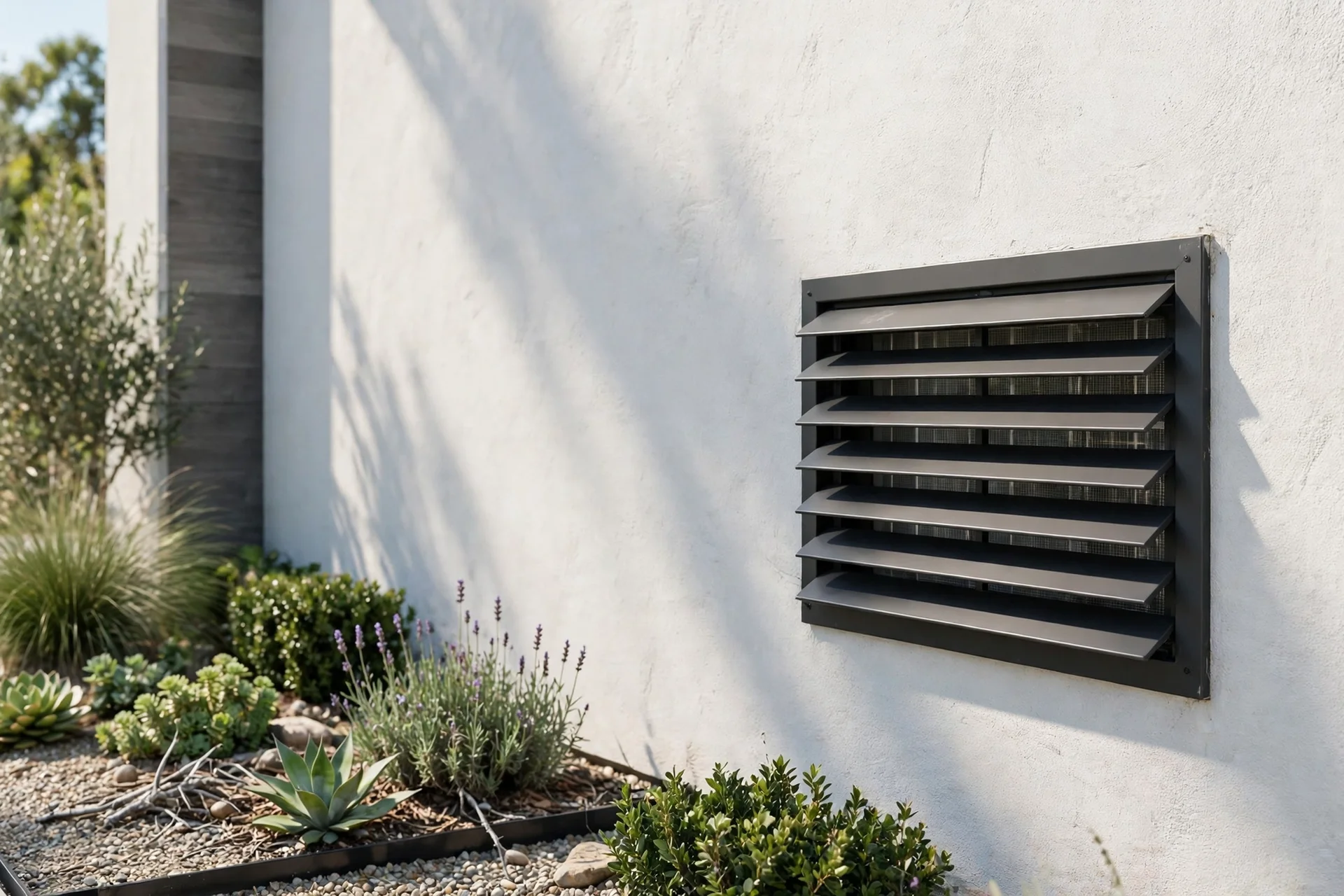
The intake termination — the hood or louvre on the outside wall — does more work than any other single component, because it is the only part that faces the weather. A good hood sheds rain away from the opening with a downward-sloping cover, keeps wind-driven snow out with a louvred face, and carries a removable screen fine enough to stop insects but coarse enough not to clog with dust in a month. The screen should be removable from outside without tools, because a screen that cannot be cleaned will be cleaned never, and a clogged screen is a closed intake.
- A downward-facing hood with a drip edge so rain runs off the cover instead of into the duct.
- A corrosion-proof screen — stainless steel or coated aluminium — that stops insects without rusting shut.
- A slight downward slope on the duct toward the outside, so any water that does get in drains out rather than pooling inside.
- A damper or backdraft shutter that closes when the system is off, so cold air, insects and dust cannot drift in on still nights.
These details are cheap and unglamorous, which is exactly why they get skipped — and why they cause so many of the complaints that get blamed on the ventilator itself. A homeowner who reports that the system is noisy, or that dust is worse since the ventilator was fitted, is often describing a missing screen, a hood facing the wrong way or a duct that slopes the wrong direction. Inspect the termination from outside every spring: a bent louvre, a torn screen or a wasp nest in the hood is a five-minute fix that restores the whole system.
Balancing Intake and Exhaust So the House Breathes Evenly
A ventilation system is balanced when the air coming in equals the air going out, and the balance is set at commissioning with dampers and fan speeds, not by guesswork. An intake that delivers more than the exhaust removes will pressurise the house, pushing warm, moist air into wall cavities where it can condense. An intake that delivers less will depressurise the house, pulling unfiltered air through every crack, gap and unsealed penetration — which defeats the entire purpose of the filtered intake, because the dust simply comes in through the back door instead.
The symptoms of imbalance are easy to recognise once you know them: doors that are hard to close, a fireplace that smokes back into the room, cold draughts around windows on windy days, or a house that smells of the garage or the crawl space. All of them point to pressure, and pressure points to balance. Ask the installer for the commissioning report — it should show the measured intake and exhaust flows in litres per second, and the two numbers should be within about ten percent of each other.
| Symptom | Likely imbalance | What to check |
|---|---|---|
| Doors hard to close, air pushing out | Too much intake (positive pressure) | Intake damper open too far; exhaust fan underperforming |
| Draughts at windows, smells from garage | Too little intake (negative pressure) | Intake filter clogged; intake damper closed |
| Fireplace smoke spilling into the room | Strong negative pressure | Exhaust fans and intake not balanced; flue undersized |
| Dusty house despite new filters | Air bypassing the intake | Unsealed cracks and penetrations pulling in unfiltered air |
Balance should be checked at commissioning and again after any filter upgrade, because a denser filter changes the airflow on the intake side.
A Filter Routine That Survives Pollen Season and Wildfire Smoke
Filters are consumables, and the maintenance schedule is part of the design, not an afterthought. In ordinary conditions a pleated intake filter lasts three to six months, but pollen season, a nearby building site or a week of wildfire smoke can load a filter in days. The reliable way to know is to look at it: hold the filter up to the light once a month, and if you cannot see light through the media, it is done, whatever the calendar says. Keep a spare filter of the correct size and MERV rating in the house, because a system run without its filter while you shop for a replacement is a system importing dust at full speed.
Smoke events deserve their own plan. When outdoor air quality is poor, the best move is often to reduce the intake rate or switch the system to recirculation with high-efficiency filtration, rather than pulling smoky air through the house at full volume. Some modern controls do this automatically with an outdoor air quality sensor; on a manual system, the homeowner needs to know where the control is and when to use it. Write the routine down and tape it to the unit — filter size, MERV rating, change interval, and what to do in a smoke event — because the person who maintains the system in three years' time will not remember a conversation from installation day.
Ventilation Intake Design FAQs
Where is the best place for a ventilation intake?
The best intake location is high on a wall facing the prevailing wind, at least three metres from any exhaust, driveway or road, and at least 1.8 metres above the ground. That combination keeps the opening clear of road dust and exhaust gases, and away from the heavy dust that sits in the lowest metre of air.
What MERV rating should a ventilation intake filter have?
Most homes do well with MERV 11, which catches pet dander, fine dust and auto emissions without excessive pressure drop. Use MERV 13 near busy roads or in wildfire country, and MERV 8 only where outdoor air is clean, and never fit a higher rating than the manufacturer specifies without checking the fan first.
How often should an intake filter be changed?
Every three to six months in ordinary conditions, and more often during pollen season, construction nearby or wildfire smoke. The reliable test is visual: hold the filter up to a light once a month, and replace it when you can no longer see light through the media.
Can an intake bring in too much dust even with a filter?
Yes, if the intake is poorly sited, the filter is the wrong rating, or the house is depressurised so air bypasses the intake through cracks and gaps. The fix is a combination of good siting, correctly rated two-stage filtration and proper balancing of intake and exhaust flows, so that all incoming air passes through the filter.
Should the intake be shut off during wildfire smoke?
During heavy smoke it is usually best to reduce the intake rate or switch to recirculation with high-efficiency filtration, rather than pulling smoky air in at full volume. If the system has an outdoor air quality sensor it may do this automatically, and on a manual system turn the intake down during the worst hours.
Final Thoughts: Clean Air Starts at the Wall, Not at the Filter
A ventilation intake is a small piece of hardware with an outsized job, and the homes that breathe best are the ones where it was designed rather than improvised.