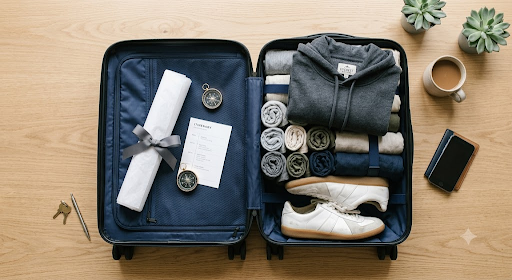
Everyone overpacks, and almost everyone knows they’re doing it while they do it. You throw in a third jacket for the weather that probably won’t happen, two extra tops for occasions you can’t quite name, and then drag the whole thing through an airport for a week without touching half of it. The problem isn’t discipline. It’s that most people pack by counting days instead of building combinations. A single heavyweight cole buxton piece worn four ways beats four pieces worn once each. Let’s fix the method rather than the willpower.
Why Counting Days Fails
The instinct is to pack one outfit per day, which sounds sensible and produces a suitcase twice the size it needs to be. Seven days becomes seven tops, seven bottoms, and a pile of backup options for good measure. The flaw is that outfits aren’t atomic units, they’re combinations, and combinations multiply. Three tops and two bottoms produce six outfits, not five items worth of coverage. Add a layer and it doubles again. So the right question isn’t how many days you’ll be away, it’s how many distinct combinations your chosen pieces generate together. That reframe alone cuts most people’s packing in half. The second failure is packing for scenarios rather than plans. People bring formal shoes for a dinner that isn’t booked, workout gear for a gym they won’t visit, and rain layers for a forecast they haven’t checked. Those hypotheticals accumulate fast. My honest opinion? Nearly everyone’s overpacking traces back to anxiety about being caught unprepared, which is understandable and almost always disproportionate to the actual risk. You can buy socks anywhere on earth. So plan for what’s scheduled, add one contingency layer, and accept that a genuinely unexpected need is solvable at your destination for less hassle than carrying the solution for a week.
Building a Travel Palette
The single most effective technique is committing to one colour family before you pack anything. When every piece sits in the same palette, everything combines with everything, and you stop needing backup options that coordinate. Pick two neutrals plus one accent and stop there. Black and grey, or navy and cream, or brown and tan, whatever you actually own. Every top should work with every bottom, which is only true if you’ve eliminated colour conflicts in advance. That’s the whole trick. Neutrals do this best because they never clash, and dark neutrals additionally hide the wear and stains that accumulate on a trip where you’re wearing things repeatedly. So a dark palette buys you extra wears per garment, which matters enormously when you’re carrying less. Test the combinations before packing rather than assuming, laying everything on a bed and physically pairing each top with each bottom. Anything that doesn’t work with at least two other pieces gets removed immediately, no exceptions. That test takes five minutes and it’s where the real reduction happens. Keep your shoes in the palette too, since footwear that only works with half your outfits forces you to bring a second pair you’d otherwise skip.
A Packing Sequence That Works
Rather than throwing things in, build your travel wardrobe in this order:
- Check the actual forecast for your dates and destination, not your general assumption about the place
- List your confirmed plans, since scheduled events determine what you genuinely need
- Choose your palette, committing to two neutrals and one accent before selecting any garments
- Pick bottoms first, usually two pairs, since they’re worn multiple times and anchor everything
- Add tops last, roughly one per two days, choosing pieces that work with both bottoms
Bottoms first is deliberate and counterintuitive. Most people pick tops first and then hunt for bottoms that match, which produces excess. Bottoms get worn repeatedly without washing, so two pairs cover a week comfortably, and choosing them first constrains your top selection usefully. Step one deserves actual attention too, since people pack for a place’s reputation rather than its current weather, and a forecast check takes twenty seconds. Step five’s ratio holds up well in practice: four tops covers a week when your bottoms and layers are doing their share of the work.
Layers Do the Heavy Lifting
The reason people overpack for weather is that they think in terms of separate outfits for separate temperatures, which is enormously inefficient. Layering solves the same problem with far less volume. A base tee, a mid-layer hoodie, and a light shell cover an enormous temperature range between them, and each piece is also wearable alone in the right conditions. Three items, many configurations. That’s the entire principle. Each layer should look complete on its own too, since a base layer you’d never be seen in publicly means you can’t actually shed down to it when it warms up, and then the system fails. So pack a proper tee rather than something you’d only wear underneath. The outer layer deserves the most thought, and a packable shell is worth more than a warmer coat for most trips, because it blocks wind and rain while compressing into almost nothing when you’re not wearing it. A heavy coat you have to carry all afternoon punishes you for bringing it. Here’s the hands-on detail worth knowing: wear your bulkiest items on the plane rather than packing them, since a coat and the heaviest shoes take up more suitcase volume than everything else combined, and wearing them costs you nothing beyond a slightly warm boarding process.
The Pieces Worth Their Space
Certain items justify their volume on almost any trip:
- One heavyweight hoodie or mid-layer, doing warmth duty and reading as a complete outfit on its own
- A packable shell, since it handles wind and rain and compresses to nearly nothing when unused
- Two pairs of bottoms in your palette, worn repeatedly and covering a full week between them
- One versatile pair of shoes plus whatever you’re wearing, since footwear is the heaviest thing you’ll carry
- Merino or synthetic socks and base layers, which resist odour far better than cotton and need less washing
That last point does more work than any other item on the list. Cotton holds moisture and starts smelling after a single wear, while merino and technical synthetics can genuinely go multiple days, which directly reduces how much you need to bring. Swapping your socks and base layers for these materials cuts more volume than any packing technique. Shoes deserve realism too, since a second pair is heavy and bulky, and most trips genuinely need only one versatile pair plus what’s on your feet. A dense hellstar hoodie earns its space precisely because it works as warmth, as a layer, and as a standalone top rather than doing only one job.
Packing the Bag Itself
How you pack matters almost as much as what you pack. Rolling generally beats folding for soft items like tees and knitwear, since rolled garments compress tighter and crease less along hard lines. Structured items like a collared shirt still fold better, so use both methods rather than committing to one. Heavy things go at the bottom near the wheels, which keeps the bag stable and stops lighter items being crushed. Shoes should be stuffed with socks and small items, because the interior volume of a shoe is otherwise completely wasted space. Packing cubes genuinely help, not by compressing much, but by keeping categories separated so you’re not unpacking everything to find one item. Leave roughly ten percent of the bag empty too, since you’ll acquire something on the trip and a completely full bag on the way out becomes an unclosable one on the way back. One honest limitation: no packing technique compensates for bringing too much, and organising an overpacked bag beautifully still leaves you dragging an overpacked bag around. The reduction has to happen before the packing does.
Final Words
Packing light is a planning problem rather than a discipline problem. Count combinations instead of days, commit to a two-neutral palette so everything pairs with everything, and pick bottoms before tops. Lean on three layers that each work alone rather than separate outfits for separate temperatures. Switch to merino or synthetic socks and base layers, wear your bulkiest items on the plane, and leave a tenth of the bag empty. Do that and a week fits comfortably in a carry-on with room to spare. You’ll wear everything you brought, which is the actual goal.
FAQ BLOCK
Q: How many tops do I need for a week?
A: Around four, if your palette is consistent and your layers are doing their share. Count combinations rather than days, since three tops and two bottoms already generate six distinct outfits.
Q: Should I roll or fold my clothes?
A: Both. Roll soft items like tees and knitwear, since they compress tighter and crease less. Fold structured pieces like collared shirts. Stuff socks inside shoes so that interior volume isn’t wasted.
Q: How many pairs of shoes should I bring?
A: One versatile pair plus whatever you’re wearing. Shoes are the heaviest, bulkiest thing you’ll carry, so wear your heaviest pair while travelling rather than packing it.
Q: What’s the easiest way to cut packing volume?
A: Switch socks and base layers to merino or technical synthetics. They resist odour for multiple wears while cotton starts smelling after one, which directly reduces how many you need to bring.
Q: How do I pack for unpredictable weather?
A: Three layers rather than separate outfits: a proper tee, a mid-layer hoodie, and a packable shell. Each should look complete alone so you can genuinely shed down as it warms up.