Most homeowners only discover groundwater pressure when water shows up where it should not be: a damp line creeping up a basement wall, a hairline crack weeping after heavy rain, or a sump pump suddenly running every few minutes. By the time these signs appear, pressure has already been building against the foundation for days or weeks. Modern perimeter monitoring systems change that sequence entirely, giving homeowners a view of what the soil and water around their foundation are doing long before damage becomes visible.
A modern foundation perimeter monitoring system is a network of sensors placed around and beneath the outside of a home that continuously measures groundwater levels, soil moisture and pore water pressure, then sends that data to a hub or phone app. When readings rise above the home’s normal baseline, the system alerts the homeowner while there is still time to clear a drain, service a pump or call a waterproofing professional. It does not stop water itself; it buys the time to act before pressure turns into seepage, cracking or flooding.
Groundwater Pressure: The Invisible Force Pressing Against Your Foundation Walls
Groundwater pressure, often called hydrostatic pressure, is the force exerted by water held in the soil around a foundation. After rain or snowmelt, the water table rises and saturated soil pushes against basement walls and floors. Concrete is strong in compression but porous, and even a well-built wall can admit water through the cove joint where the wall meets the floor, through shrinkage cracks or through the floor slab itself when pressure is high enough.
- Efflorescence, the white mineral crust left behind when water evaporates from concrete, signals repeated moisture movement through a wall.
- Seepage at the cove joint, where the wall meets the floor slab, is one of the earliest signs of rising hydrostatic pressure.
- A sump pump that cycles more often without a matching rainstorm suggests groundwater conditions have changed.
- Musty odours and damp patches that appear only after wet weather point to pressure-driven intrusion rather than a plumbing leak.
How Perimeter Monitoring Systems Detect Groundwater Pressure Changes
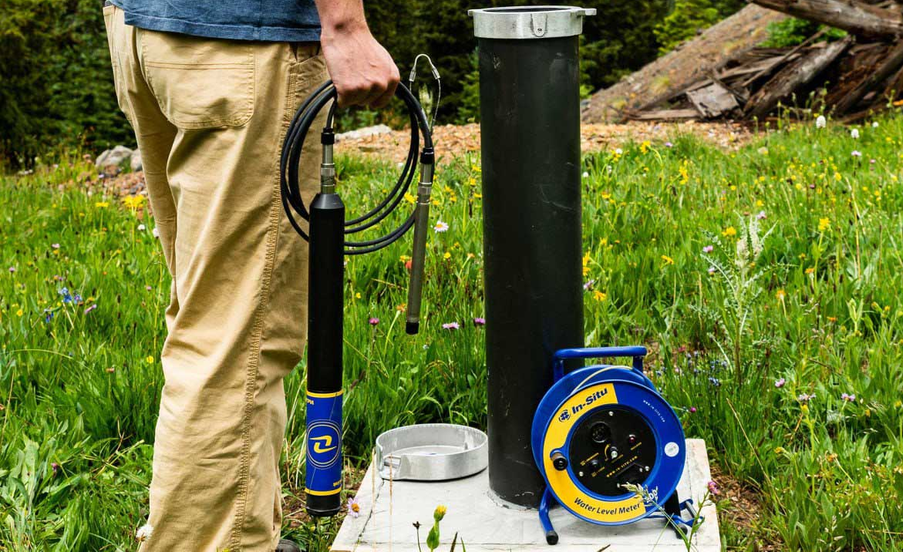
A perimeter monitoring system works by measuring the conditions that precede water entry rather than the water entry itself. Piezometers installed in small boreholes around the foundation measure pore water pressure directly, reporting how hard groundwater is pushing at a given depth. Capacitive soil moisture sensors track how saturated the surrounding soil is, and because soil saturation is the direct precursor to a pressure event, a spike in saturation gives warning before pressure reaches the wall. Smart sump pump monitors add a third layer by tracking water level in the pit, pump cycle frequency and run duration.
- Piezometers measure pore water pressure at depth, the most direct indicator of the force acting on foundation walls.
- Soil moisture sensors reveal saturation in the backfill zone before pressure builds to the point of seepage.
- Sump pump monitors translate water level and cycle data into an early warning that groundwater is rising.
- Weather data integration lets some systems correlate forecast rainfall with current soil conditions and issue predictive alerts.
Piezometers, Soil Sensors and Sump Monitors: The Instruments Behind Perimeter Monitoring
Piezometers come in three main types, and the choice depends on depth and accuracy needs. Standpipe piezometers are simple tubes with a porous tip that let water rise inside them, and they suit shallow residential applications. Vibrating wire piezometers use a tensioned wire whose vibration frequency changes with pressure, and they are preferred for deeper installations and for long-term automated logging. Pneumatic piezometers use gas pressure to balance water pressure and are chosen where very precise measurements are needed.
| Instrument | What it measures | Typical placement | Best for |
| Standpipe piezometer | Groundwater level and pore pressure | Shallow borehole beside the footing | Simple, low-cost level tracking |
| Vibrating wire piezometer | Pore water pressure at depth | Borehole below footing level | Deep or long-term automated monitoring |
| Capacitive soil sensor | Soil moisture and saturation | Backfill at several depths | Early warning before pressure peaks |
| Smart sump monitor | Pit water level and pump cycles | Inside the sump pit | Checking whether drainage is coping |
Reading the Signals: What Rising and Falling Water Levels Mean for Your Home
A rising water level after rain is normal; the question is how high it climbs and how quickly it falls again. A level that returns to baseline within a day or two shows the perimeter drain and soil are doing their job. A level that keeps climbing after the rain has stopped, or that stays elevated for a week, suggests drainage is restricted or the water table itself has risen, and that is when pressure against the wall becomes a real concern.
- A steady climb after rain that peaks and falls within a day or two usually means drainage is working.
- Levels that stay high for a week after wet weather point to restricted drainage or a rising water table.
- One sensor diverging sharply from the rest often means a local issue, such as a clogged drain or a shifted sensor.
- A pump cycling far more often than its established baseline, with no matching rainfall, deserves an inspection.
Where Perimeter Sensors Belong Around a Residential Foundation
Placement matters more than the number of sensors. The most informative locations are the corners of the foundation, where water tends to collect, the low side of the lot where runoff gathers, and any point where a downspout discharges near the wall. A sensor near the sump pit anchors the whole system, because pit behaviour is the clearest check on whether the drainage system is keeping up. Homes with a history of seepage should also have a sensor near the wall section that leaked before.
- Foundation corners and the low side of the lot are the first places groundwater collects.
- A sensor beside each downspout discharge point catches the most common cause of local saturation.
- Piezometers belong at or just below footing level, where pressure acts directly on the wall.
- Pairing a shallow and a deep soil sensor shows whether saturation is superficial or runs the full depth of the backfill.
Installing a Perimeter Monitoring System Without Excavating Your Whole Yard
Installing a perimeter system sounds invasive, but modern wireless sensors have made it far less disruptive than most homeowners expect. Piezometers go into narrow boreholes drilled with a small auger, soil sensors are pushed into hand-dug pits or installed through a slim probe, and sump monitors simply clip into the existing pit. Most residential installations take a day or less, and the yard is left with a few discreet caps flush with the ground rather than a torn-up trench.
The work still deserves care. Boreholes must be sealed properly so they do not become new paths for surface water to reach the footing, sensors need a clear wireless path to the hub, and the system should be commissioned with a baseline recording period before any alert thresholds are set. A licensed waterproofing contractor or geotechnical technician is the right choice for piezometer installation, while many homeowners handle sump monitors and plug-in soil sensors themselves.
- Narrow boreholes and wireless sensors keep installation to a day or less with minimal disturbance to landscaping.
- Every borehole must be sealed at the surface so it cannot channel rainwater down to the footing.
- Allow several weeks of baseline recording before setting alert thresholds, so alerts reflect the property’s normal range.
- Battery-powered sensors need a replacement schedule, and mains-powered hubs need a location with reliable Wi-Fi.
Seasonal Groundwater Shifts and the Alert Thresholds That Matter
Groundwater follows the seasons. Spring snowmelt and autumn storms usually bring the highest levels, summer drought the lowest, and a wet winter can keep the water table elevated for months. A monitoring system that ignores this rhythm will either cry wolf every spring or stay silent during a genuine event. That is why thresholds should be set from the property’s own recorded baseline rather than from a generic number, with separate alert levels for a watch condition and an act-now condition.
A sensible approach is a two-stage alert: a watch alert when readings pass the top of the normal seasonal range, prompting a check of downspouts, drains and the sump pump, and an urgent alert when readings approach the level at which seepage has occurred before. Recording each alert alongside the weather and the action taken builds a history that makes the next season’s thresholds sharper.
| Condition | Typical reading pattern | Sensible response |
| Normal seasonal rise | Levels climb after rain, fall within days | No action; confirm drains are clear |
| Watch condition | Readings pass the top of the normal range | Check downspouts, gutters and sump pump |
| Urgent condition | Levels near a past seepage point | Inspect drainage, run pump test, call a professional |
| Sensor fault | One sensor flatlines or spikes alone | Check battery and connection before acting |
Perimeter Monitoring Mistakes That Leave Homeowners Blind to Rising Water
The most common mistake is installing a single sensor and treating its readings as the whole story. Groundwater is uneven around a house, and one sensor on the dry side can report calm conditions while the low side is saturating. The second mistake is skipping the baseline period and setting thresholds by guesswork, which produces either constant false alarms that get ignored or silence during a real event. A third is neglecting maintenance: batteries die, wireless signals drop, and sensors drift out of calibration.
Professional monitoring systems typically need annual calibration to stay accurate, and homeowners should treat sensor checks as part of seasonal home maintenance, alongside gutter cleaning and sump pump testing. A system that is installed and then forgotten is little better than no system at all, because the first sign of failure is usually the alert that never arrives.
- One sensor cannot represent a whole perimeter; groundwater levels vary from wall to wall.
- Thresholds set without a baseline period cause false alarms or, worse, silence during real events.
- Dead batteries and lost wireless connections are the most common reasons a system fails quietly.
- Skipping annual calibration lets readings drift until they no longer reflect real conditions.
Groundwater Pressure Monitoring FAQs for Homeowners
Can a perimeter monitoring system stop water from entering my basement?
No. Monitoring is a detection and alerting system, not a remediation system. It tells you when pressure is rising so you can clear a drain, service a pump or bring in a professional before water gets in, but the actual protection still comes from drainage, waterproofing and grading.
How deep should groundwater sensors sit around a foundation?
Piezometers should sit at or just below footing level, where pressure acts on the wall and floor. Soil moisture sensors work best at two depths, one shallow and one deep, so the system can distinguish surface wetness from full-depth saturation of the backfill.
How often do perimeter monitoring sensors need calibration?
Professional systems generally need calibration about once a year to maintain accuracy. Homeowners should also check batteries and wireless connections seasonally, and re-check calibration after any work that disturbs the sensors, such as landscaping or excavation nearby.
Do wireless perimeter sensors work reliably through concrete and soil?
Wireless sensors communicate above ground to a hub, so the sensor itself sits in the soil while its antenna or transmitter stays near the surface. Range depends on the system, but most residential setups place the hub in a basement or garage window and cover the full perimeter without difficulty.
What does a sudden spike in sump pump cycles tell me about groundwater?
A pump that starts cycling far more often than its usual pattern, without a matching rainstorm, usually means groundwater conditions have changed. It can point to a rising water table, a blocked perimeter drain forcing more water to the pit, or a failing check valve letting water flow back.
Is perimeter groundwater monitoring worth it for a home that has never flooded?
It is often most valuable for exactly those homes. A house that has never flooded has no track record to warn its owner, and the first flood is usually the expensive one. Monitoring costs far less than a single water-damage repair, and it is especially worthwhile on lots with a high water table or a history of wet basements nearby.
Final Thoughts: Keeping Groundwater Pressure Visible Before It Becomes Foundation Damage
Groundwater pressure is one of the few forces that can damage a home while remaining completely invisible, and that invisibility is what makes it expensive. A modern perimeter monitoring system does not change the soil or the water table, but it removes the invisibility, turning a hidden threat into a set of readings you can watch, understand and act on. For homeowners on wet lots, with older foundations or with a basement they rely on, that visibility is worth far more than the modest cost of the sensors. Install the system, learn your property’s baseline, keep it maintained, and let the data warn you while there is still time to act.