An outdoor shower is one of the simplest luxuries a home can offer: a hot rinse after the pool, a cool-down station on a summer evening. The part that trips up most homeowners is what happens to the water after it hits the ground. Without a drain, a beloved outdoor shower quickly becomes a muddy patch, a mosquito nursery, and, if it sits too close to the house, a slow threat to the foundation.
The Short Answer: Which Outdoor Shower Drain Works When There Is No Sewer Nearby
For most homes with no sewer connection at the shower site, a gravel drainage bed paired with a buried dry well is the best drainage solution for an outdoor shower. The gravel bed under the shower catches water and lets it soak away, while the dry well — a pit lined with landscape fabric and filled with clean stone — gives larger volumes somewhere to go when surface soil cannot absorb them fast enough. If the soil is heavy clay or the shower will see daily family use, add a French drain: a shallow, sloped trench with a perforated pipe that carries water to a safer dispersal point. A sewer connection is the most reliable but most expensive option, used mainly when code requires it.
Start With the Ground Beneath Your Feet: A Five-Minute Percolation Check
Every drainage decision starts with one question: how fast does water disappear into the soil at the exact spot you plan to build? Sandy or loamy soil may swallow a bucket of water in a minute; compacted clay may still hold a puddle half an hour later. Guessing wrong means overbuilding a system you never needed, or watching your shower pad turn into a bog by midsummer.
A simple bucket test gives a useful answer before you spend anything. Dig a hole about a foot deep and wide, fill it with water, and time how long it takes to drain. Repeat once the hole is wet, because dry soil always absorbs faster on the first fill. As a rough guide, if the second fill drains at about an inch per hour or faster, the ground can handle a gravel bed or dry well. If water is still sitting there after thirty minutes, plan on a French drain or a larger dry well. Check the slope too — water must run away from the house — and call your utility-locating service before digging deeper than a spade’s depth.
The Gravel Shower Pad: The Simplest Drain for a Rinse-Only Outdoor Shower
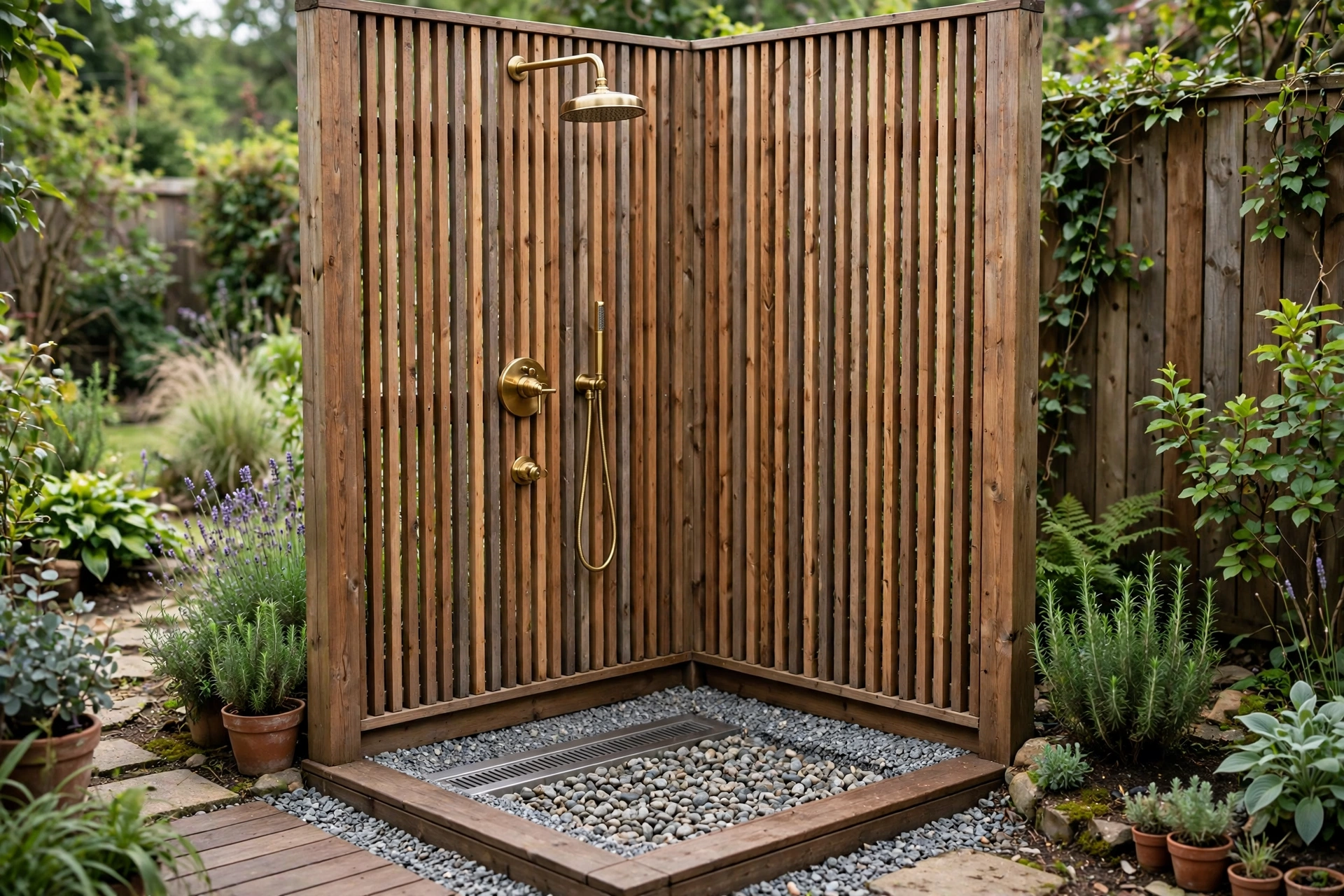
For a shower used a few times a week for rinsing, a gravel pad is often all you need. Instead of a solid slab that forces water to run off somewhere, the shower floor itself is the drain: water falls through gaps in a deck or straight onto a bed of stone and percolates into the soil below.
A well-built pad has layers. Excavate the shower footprint, plus a foot or two beyond it, to four to six inches deep. Line it with permeable landscape fabric, which stops soil migrating upward and clogging the stone. Fill with three to four inches of clean, washed gravel, typically three-quarter-inch to one-and-a-half-inch stone — smaller pea gravel looks tidy but packs down and drains more slowly. Its limits are real: it suits light use and free-draining soil, not daily showers, clay soil, or low spots.
Building a Buried Dry Well That Keeps Up With Daily Showers
A dry well is the workhorse of outdoor shower drainage without plumbing. It is an underground pit that receives shower water, stores it in the voids between stones, and releases it slowly into the surrounding soil over hours rather than minutes. Two people taking five-minute showers at 2 gallons per minute produce about 20 gallons, and a pit three feet deep and three feet across holds ample storage for that, provided the soil drains between uses. In clay soil, go bigger.
Dig at least 10 feet from the foundation and property lines, clear of septic parts, wells, and buried utilities.
Excavate 3 to 4 feet deep and 2 to 3 feet across, keeping the sides as vertical as the soil allows.
Line the pit with permeable geo-textile fabric, leaving excess to fold over the top later.
Run a short pipe from the shower pad into the gravel bed, then backfill with clean washed gravel to within 12 inches of the surface.
Fold the fabric over the top and cover with topsoil and turf so the well disappears into the lawn.
Pre-formed dry well units are a worthwhile alternative in sandy soil. Whichever form you choose, the fabric lining and the setback from the house decide whether a dry well lasts.
When a French Drain Beats a Dry Well for a Soggy Corner
A dry well stores water and waits for the soil to absorb it. A French drain moves water somewhere better. That distinction matters where soil will not cooperate: heavy clay, a high water table, a shower tucked into a low corner, or a slope that sends rainwater toward the pad. In those conditions a dry well fills faster than it empties. A French drain is a shallow trench, typically 12 to 18 inches deep, running downhill to a dispersal area. The trench holds a perforated pipe wrapped in filter fabric and surrounded by gravel, sloping at roughly a quarter inch per foot so water never sits in the pipe. A catch basin at the shower end keeps sand and leaves out of the pipe.
Sending Shower Water to the Garden: Mulch Basins and Plant-Friendly Dispersal
Where local rules allow greywater reuse, an outdoor shower can become a small irrigation asset. The simplest version is a shallow mulch basin: a depression six to twelve inches deep, filled with wood-chip mulch and planted with thirsty, non-edible ornamentals. Shower water spreads through the mulch and soaks into the root zone, while the mulch filters residue and prevents ponding and odour. The boundaries are firm: greywater goes to ornamentals, not vegetable beds or fruit trees, and must never pool on the surface. Use liquid, biodegradable soaps without boron, bleach, or antibacterial agents.
Comparing the Main Outdoor Shower Drainage Options
No single system wins on every site — the right choice depends on use, soil, distance from the house, and local rules.
Costs here are estimates only.
What About Soap, Shampoo, and Sand? Greywater Rules That Decide Your Drain
Here is where many outdoor shower projects quietly break the rules. Shower water is greywater, and greywater is regulated differently from rainwater in many areas. Some municipalities allow ground dispersal of rinse water and water with ordinary biodegradable soap, especially through a dry well or mulch basin. Others require soapy water to go to the sanitary sewer, and several jurisdictions have tightened greywater rules in recent years. If the shower will be used only for rinsing, ground drainage is widely accepted. If soap and shampoo will be used, check with your local building department before you dig, describing the shower, the drainage method, and the distance from the house. Sand and hair matter too: a strainer at the drain inlet, cleaned regularly, protects every downstream option.
Ponding, Smells, and Sinking Gravel: Fixing an Outdoor Shower Drain That Stopped Working
Most drainage failures announce themselves gradually: water lingers longer after each shower, gravel sinks in one corner, a musty smell appears. Most are fixable without rebuilding.
- Water pooling on the pad: stone has compacted or silt has washed in. Rake the top layer and top up with clean gravel.
- A dry well that stays full: the fabric lining has clogged with silt. Replace it if accessible; otherwise a French drain to better soil may be the fix.
- Smells near the drain: trapped hair and soap scum are decomposing in standing water. Clean the catch basin and remove any low spot where water sits.
- Gravel migrating onto the lawn: edging has failed or the pad is undersized. Add solid edging and extend the pad a foot beyond the shower footprint.
- Water appearing near the foundation: stop using the shower until the drainage path is corrected.
Cold Snaps, Mosquitoes, and Muddy Feet: Seasonal Upkeep for an Open-Air Drain
An outdoor shower drain is exposed to weather in a way an indoor drain never is. In autumn, clear leaves from the pad, catch basin, and French drain inlet before they mat down and seal the surface. In freezing climates, drain exposed supply pipes before the first hard frost — a burst pipe is a far bigger problem than a frozen drain, since buried gravel and dry wells generally keep working through winter, but standing water in an exposed trap or shallow pipe will crack it. Mosquitoes breed in water standing for as little as a week, so a correctly built system drains within hours and is mosquito-safe by design.
How Much an Outdoor Shower Drain Costs, From a Bag of Gravel to a Plumber’s Tie-In
Budgeting is mostly a question of how much digging and pipe you take on. A gravel pad is a materials-only project: bagged stone, landscape fabric, and edging, typically a few hundred dollars at most. A French drain’s cost grows with its length, because every extra foot is more trench, pipe, gravel, and garden restoration. A sewer connection sits in a different band: trenching, pipe, trap and vent, backfill, restoration, and a permit commonly total $1,500 to $5,000 or more.
Getting a Plumber Involved: The Jobs That Are Not Worth Doing Solo
Much of outdoor shower drainage is genuinely DIY-friendly: digging a gravel pad, building a dry well, laying a short French drain. Some jobs are not. Call a licensed plumber or drainage contractor if the shower needs a sewer connection, because that work involves a trap, a vent, correct fall over a long run, and usually a permit and inspection. Call one too for showers near the house, septic systems, high water tables, or any history of foundation dampness. A short consultation is inexpensive insurance.
Outdoor Shower Drainage Questions Homeowners Ask Before They Dig
Can an outdoor shower drain straight onto the ground?
In many areas, yes, for rinse water on permeable soil well away from the house. Exceptions are soapy greywater where local rules restrict it, and showers close to foundations.
How far should an outdoor shower drain sit from the house?
Keep the pad a few feet from the wall and any dry well at least 10 feet from the foundation and property lines. If space forces the shower closer, a piped drain to a farther dispersal point is safer.
Does an outdoor shower need a trap like an indoor shower?
Not usually, when water disperses to soil through gravel or a dry well, because there is no sewer gas to block. Where the drain connects to a sewer, a trap and vent are normally required.
What do I do with sand and hair from an outdoor shower?
Fit a strainer at the drain inlet and clean it regularly. Sand is the main enemy of gravel beds and French drains: it fills the voids between stones and pipe perforations.
Will an outdoor shower drain work in clay soil?
Poorly, unless you help it. A gravel pad on clay will pond, and a small dry well will fill faster than the clay can empty it. On clay, use a larger dry well, a French drain to better soil, or a sewer connection.
Can shower water be reused on garden plants?
Yes, with limits. Greywater can irrigate ornamental plantings through a mulch basin if you use biodegradable, boron-free products and keep water below the mulch surface. Never use it on vegetables or fruit trees.
Final Thoughts: Pick the Drain That Matches Your Soil, Not the Shower You Admire
The best drainage solution for an outdoor shower with limited plumbing access is rarely the most elaborate one. It is the one that matches three facts about your site: how fast your soil absorbs water, how often the shower will actually be used, and what your local rules allow for greywater. Start with the percolation test, build the simplest system that honestly handles your water volume — a gravel pad for occasional rinsing, a dry well for regular family use, a French drain for difficult ground — and keep the discharge well away from the house. Do that, and the shower stays a small daily pleasure, not a muddy problem at the back door.