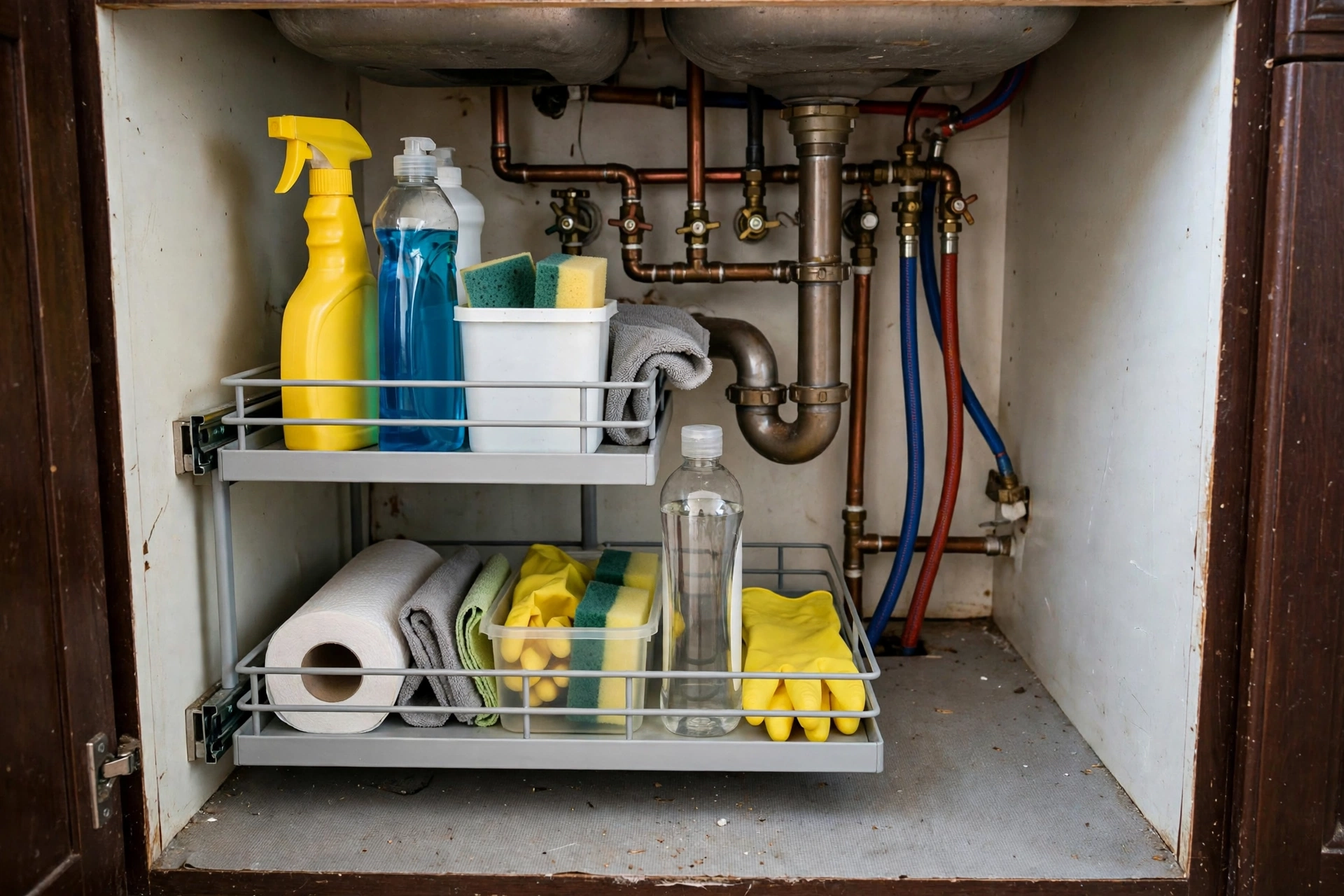
Open the cabinet under a kitchen sink and the problem is obvious: a drain pipe runs through the middle, a trap hangs below it, supply lines crowd the back, and a garbage disposal or filter may take up one side entirely. It is the most-used storage space in many kitchens and also the least rectangular, which is why a standard shelf or a pretty set of bins so often ends up unused, wedged in at an angle, or returned.
The short answer is to measure the cabinet in three dimensions, sketch the plumbing, and then choose the simplest organizer that fits around the pipes rather than the largest one that looks good online. Pull-out drawers suit daily cleaning supplies, tiered risers suit tall bottles and backups, and adjustable U-shaped systems suit the most awkward layouts. The sections below walk through measuring, matching the organizer type to the cabinet, and avoiding the mistakes that cause most returns.
Mapping an Awkward Under-Sink Cabinet Before Buying Anything
Start by emptying the cabinet completely and looking at it with a torch. Note where the drain and trap sit, whether the waste pipe runs left, right, or straight back, and where the hot and cold supply valves are. Note any disposal, water filter, or dishwasher connection, and check whether the cabinet floor is flat or raised around the plumbing. A photo taken from the front, with the door fully open, is a useful shopping reference.
Then measure the interior, not the outside of the cabinet. Measure width between the inner faces of the sides, depth from the front frame to the back panel, and height from the cabinet floor to the lowest point of the sink bowl or trap. Measure on both sides of the drain, because the usable height and depth often differ left and right. Record the door opening width as well, since a pull-out unit must pass through it, not just fit inside the box.
The Three Measurements That Decide an Under-Sink Organizer Fit
Width decides whether a unit slides in without catching the frame or hinges. Depth decides whether the door will close once the organizer is loaded, because bottles and handles often project further than the shelf itself. Height decides whether a two-tier unit or a tall spray bottle will clear the sink bowl. If any one of these is guessed, the organizer will either jam, block the door, or leave a tall gap of wasted space above it.
A practical rule is to leave at least a small clearance on each side for sliding parts and for your hand. Pull-out trays need room to run, door-mounted racks add thickness to the door, and stackable bins need room to lift out. Write the three interior measurements on a card and compare them with the product dimensions listed by the seller, including the assembled height with bottles in place, not just the empty unit.
Under-Sink Organizer Types Compared for Awkward Kitchens
No single type wins for every cabinet. A tiered riser is the best first buy for a cabinet with open floor space beside the drain, because it is cheap and needs no fitting. A pull-out drawer is better when the cabinet is deep and the back is otherwise unreachable. An adjustable U-shaped system is the answer when the trap sits in the middle and a single shelf cannot span the space. Choose by the plumbing layout, not by the photograph.
Matching Organizer Materials to a Damp Under-Sink Environment
Under-sink cabinets are damp by nature. Pipes sweat, small drips happen, and cleaning sprays leak. Coated steel, stainless steel, and sturdy plastic all cope better than bare wood or cardboard, which swell and harbour odour. Wire or ventilated metal has a further advantage: air circulates, drips fall through to a tray below, and you can see the lower tier without crouching and pulling everything out.
Whatever the material, add a shallow drip tray or a lipped tray under the bottles. It catches the leak that would otherwise soak the cabinet floor, and it makes cleaning a spill a matter of lifting out one tray rather than emptying the whole cabinet. Avoid storing paper products, cardboard boxes, medicines, or electronics under the sink, because even a well-organised cabinet remains a damp, chemical-adjacent space.
Zoning an Under-Sink Cabinet So Daily Items Stay Reachable
Once the organizer fits, zone the contents by frequency. Daily items such as dish soap, a sponge, and a surface spray belong at the front or on a pull-out tray that comes to you. Weekly items such as floor cleaner and dishwasher tablets belong on the upper tier or in a labelled bin. Backups and rarely used items belong at the back or on the highest shelf, where reaching them occasionally is acceptable. If everything is treated as daily, the cabinet will drift back into chaos within a month.
- Keep a small caddy for the items you carry to another room, so the cabinet is not emptied every time you clean.
- Group by task, not by bottle size: dishwashing together, surface cleaning together, and laundry or pet supplies apart.
- Label bins if more than one person uses the kitchen, because an unlabelled bin is quickly treated as a junk drawer.
Revisit the zones after a few weeks of real use. If a bottle is always left on the worktop, it probably belongs in a more accessible spot, or it does not belong under the sink at all. A good organizer is judged by whether the cabinet stays usable, not by whether it looked tidy on installation day.
Installing an Under-Sink Organizer Without Blocking Pipes or Valves
Dry-fit everything before fixing anything. Slide the unit in empty, close the door, open it again, and pull any drawers fully out. Check that no part presses against a supply line, a flexible hose, or the trap, because vibration and pressure can loosen a joint over time. Check that the shut-off valves remain reachable without removing the organizer, since an emergency leak is the worst time to discover that a valve is buried.
If the unit needs screws, drill only into the cabinet floor or sides, never into a pipe, and check what lies behind the panel before drilling. For rented homes, prefer no-drill options such as tension rods, stackable trays, and door-mounted racks, which leave no marks. Leave a small gap around the trap for future maintenance, and do not seal the organizer to the plumbing with tape or filler, which will make a plumber’s job harder later.
Under-Sink Organizer Mistakes That Lead to Returns
The most common return reason is simple: the buyer measured the outside of the cabinet, or measured only the width, and the unit did not fit the interior height or depth. The second is buying a fixed shelf for a cabinet whose trap sits in the middle, leaving a shelf that cannot be installed without cutting. The third is choosing a deep bin that hides everything at the back, so the household stops using the back half of the cabinet entirely.
Other mistakes are quieter. A door rack that is too thick stops the door closing, a tall bottle that clears the shelf but not the sink bowl prevents the tier from fitting, and a unit that blocks the disposal switch or the filter housing creates a daily annoyance. Each of these is avoided by the same habit: measure first, dry-fit second, and only then load the cabinet with supplies.
Seasonal Checks and Leak Spotting Under the Kitchen Sink
An organizer that fits perfectly on installation day can still fail quietly if a slow leak develops behind it. Make a habit of checking under the sink every few months, and always after any plumbing work, a new appliance installation, or a period of very cold weather. Pull out the front tray, shine a torch along the trap and supply lines, and look for damp spots, swollen cabinet flooring, a musty smell, or white mineral deposits around joints. Catching a drip early usually means tightening a fitting or replacing a washer, while catching it late can mean replacing the cabinet floor.
Use the check as a chance to reset the zones as well. Remove anything that has migrated to the wrong bin, wipe the drip tray, and throw away empty bottles and dried-out sponges that are taking up prime front-row space. If a bottle has leaked, clean the tray and the shelf beneath it before putting anything back, because sticky residue attracts dust and makes the next spill harder to clean. A ten-minute seasonal check keeps the organizer working and protects the cabinet itself, which is far more expensive to repair than any organizer.
Final Thoughts: Picking an Under-Sink Organizer That Fits Your Pipes, Not Just Your Pinterest Board
The right under-sink organizer is rarely the most elaborate one. It is the one that fits your three interior measurements, splits around your trap, keeps daily items at the front, and leaves the valves reachable. Measure the cabinet, sketch the plumbing, choose the simplest type that matches that sketch, and the awkward space under your kitchen sink will finally work as hard as the rest of the kitchen.
Under-Sink Organizer Questions for Awkward Kitchen Cabinets
What should I measure before buying an under-sink organizer?
Measure the interior width, depth, and height on both sides of the drain, plus the door opening width. Measure height to the lowest point of the sink bowl or trap, not to the worktop, because that is the clearance your organizer must respect.
What organizer works best when the trap is in the middle of the cabinet?
An adjustable U-shaped system or two separate risers, one on each side of the trap, usually works best. A single fixed shelf will not span a central trap without cutting, and a deep bin will waste the space beside it.
Are pull-out drawers worth it under a kitchen sink?
Yes, if the cabinet is deep and the opening width matches the unit. Pull-out drawers bring the back of the cabinet forward, which is where most under-sink storage is wasted. Check slide clearance and hinge clearance before ordering.
What material is best for an under-sink organizer?
Coated or stainless steel and sturdy plastic cope best with damp conditions. Ventilated wire lets air circulate and drips fall through to a tray, while a lipped tray underneath catches leaks before they reach the cabinet floor.
Can I use a door-mounted rack under the kitchen sink?
Yes, for light items such as sponges, gloves, and small bottles, provided the rack thickness still lets the door close. Measure the gap between the door and the frame when closed, because racks add thickness that a tight door cannot absorb.
What should not be stored under the kitchen sink?
Avoid paper products, cardboard, medicines, and electronics, because the cabinet is damp and chemical-adjacent. Keep cleaning supplies, dish products, gloves, and trash bags there, and store anything sensitive elsewhere.