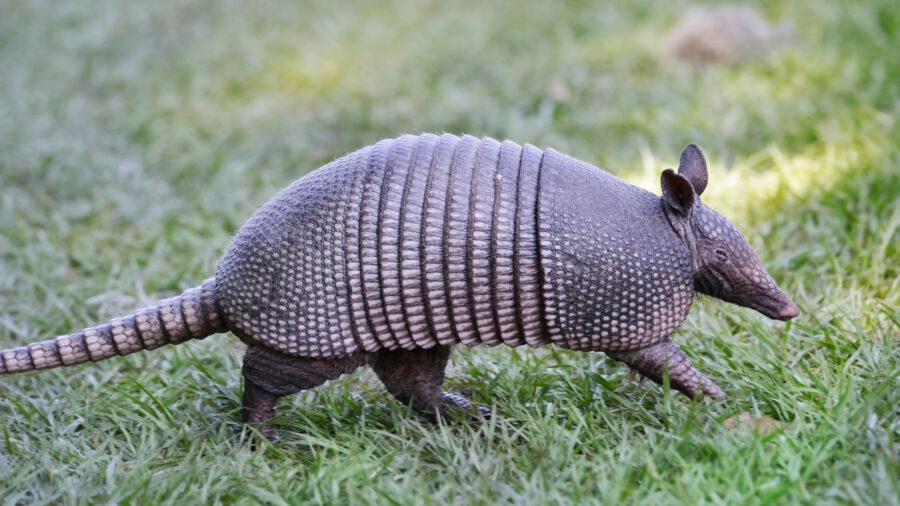
Fresh holes across a lawn do not automatically prove that an armadillo is responsible, because skunks, squirrels, raccoons, moles and birds also disturb soil while searching for food. Correct identification prevents wasted effort, unnecessary lawn damage and the accidental capture of other wildlife. Because armadillos use strong claws and long snouts to find insects, earthworms and other invertebrates, homeowners should compare the holes’ shape, depth, pattern, location and timing before choosing an appropriate response for the property and surrounding landscape.
Look at the Shape and Depth of the Holes
Armadillo feeding holes are generally shallow, roughly circular and tapered toward the bottom. Many resemble an ice cream cone pushed into the soil, with the wider opening at the surface. Individual holes are commonly several inches across and may extend up to about six inches deep.
The damage rarely consists of one isolated opening. A foraging armadillo can create numerous holes across a lawn or garden during a single night. Loose mulch may look rooted or pushed aside, while sections of turf can appear punctured rather than lifted in complete sheets.
This pattern helps distinguish armadillo activity from several common alternatives. Squirrels often create smaller depressions while burying or recovering food. Raccoons are more likely to pull back or roll sections of sod, while moles leave raised surface tunnels and soil mounds. Skunks can produce similar cone-shaped holes, but their excavations are often smaller and shallower.
Hole dimensions alone are not conclusive. Homeowners should compare their size with the surrounding damage and look for additional evidence before selecting a control method.
Consider Where and When the Damage Appears
Armadillos forage in lawns, gardens and mulched areas for insects and other invertebrates. Moist, irrigated soil is particularly attractive because it is easier to dig. Numerous holes appearing overnight are a strong sign of armadillo activity.
The location of the holes can also reveal how the animal enters and moves through the property. Armadillos often travel beside:
- Fences and retaining walls
- Buildings and sheds
- Logs and dense vegetation
- Garden borders and wooded edges
- Established gaps beneath gates
Repeated damage along one of these features is stronger evidence than random holes scattered without a recognizable route. A motion-activated camera can provide confirmation without requiring the homeowner to watch the yard throughout the night.
Search for Tracks, Worn Paths and Burrows
Fresh tracks in soft soil can strengthen the identification. Armadillo prints may show prominent claw marks, and a narrow tail drag can sometimes appear between or beside the footprints. Tracks are easiest to find near muddy garden beds, irrigation zones and regular entry points.
Repeated travel may create a narrow path through grass or beneath a fence. Because armadillos often follow the same barriers, these routes may connect feeding areas with nearby cover. Disturbed soil near the bottom of a fence can indicate that the animal has pushed underneath rather than climbed over it.
A burrow is different from a feeding hole. Burrow entrances are considerably larger and may appear beneath brush piles, tree roots, decks, sheds or other protected locations. Fresh soil, tracks and repeated nighttime activity around the opening can suggest current use. Homeowners should avoid reaching into a suspected burrow or attempting to handle an animal directly.
No single print, path or opening confirms the culprit. However, several matching signs make an armadillo diagnosis much more reliable.
Respond Only After Confirming the Animal
Repairing holes will provide only temporary results if the animal keeps returning. Smooth damaged areas and check for fresh digging, tracks or camera activity the next morning. Avoid broad insecticide treatments unless a specific turf pest has been confirmed.
Where trapping is lawful and necessary, appropriately sized Armadillo traps should be placed beside active routes, pronounced damage or known entry points. Guide boards arranged in a wide funnel can direct the animal toward the entrance as it follows a barrier. Random placement in the center of the lawn is much less likely to intercept its normal movement.
Every live trap must be checked daily and disabled whenever regular monitoring is impossible. Trapping, handling and relocation requirements vary by state and municipality, so homeowners should verify local regulations before setting a trap. A wildlife control professional may be necessary when the species remains uncertain or the homeowner cannot manage a captured animal lawfully.
Product quality also matters. Buying from a trusted Armadillo trap seller can provide access to suitable dimensions, placement instructions, replacement components and support based on the trap’s specific design.
Conclusion: Confirm the Signs Before Taking Action
Multiple cone-shaped holes, overnight damage, disturbed mulch and repeated activity beside fences or wooded edges can point to an armadillo. Tracks, worn routes and nearby burrows provide further evidence, but homeowners should evaluate the complete pattern instead of relying on one hole.
Accurate identification leads to a more targeted response and reduces the risk of treating the wrong problem. Once armadillo activity is confirmed, careful placement, daily monitoring and compliance with local wildlife rules become more important than hurried attempts to stop the damage.