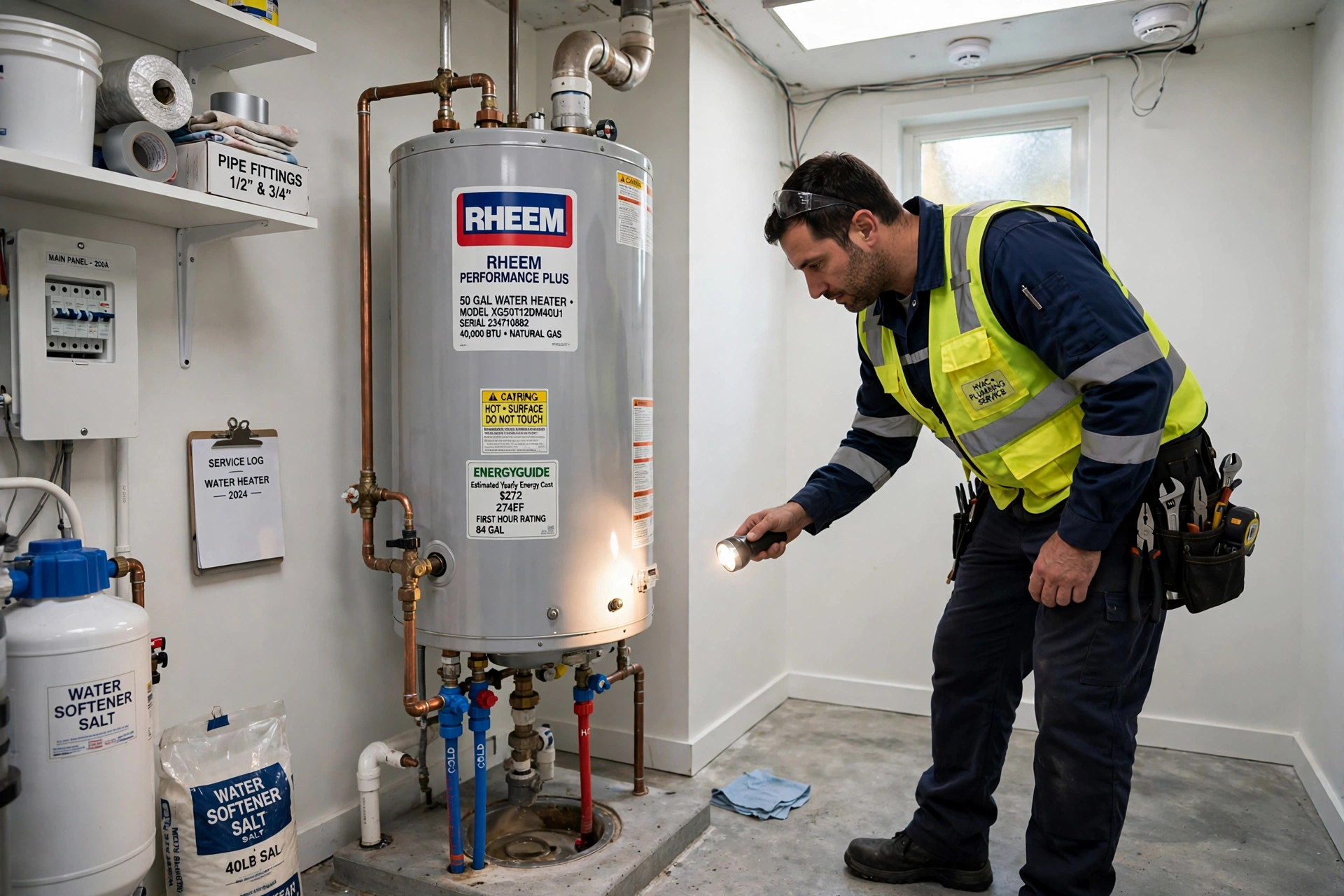
Most water heaters do not fail without warning. Long before a tank bursts or the hot water disappears, the unit leaves clues: a faint rumble when it fires up, a tinge of rust in the morning shower, a damp ring on the floor that was not there last month. Because these clues appear during ordinary life rather than a crisis, they are easy to brush off — but a homeowner who reads them during routine maintenance can usually choose the timing of a repair, instead of having it chosen by a flooded utility room.
- In short: rusty or discolored hot water, rumbling or popping noises, moisture around the base or fittings, a shrinking hot-water supply, a dripping relief valve, and an unexplained jump in energy bills are the early warning signs that a water heater needs attention. Any one deserves a closer look; two or more together, especially past ten years of age, usually mean planning a replacement rather than another repair.
Your Tank Talks First: Why Small Hot-Water Changes Deserve a Second Look
A storage water heater is one of the most predictable appliances in a home. Most conventional tank units last roughly eight to twelve years and ask for very little: an annual flush, an occasional anode rod check, and a quick visual inspection now and then. Because the tank sits out of sight in a garage, basement, or closet, it is easy to forget entirely — and that is why early warnings get missed. A slow leak can run for weeks behind stored boxes, and the steel lining wears out from the inside, so the outside can look fine while the interior is already failing.
One habit makes every other warning sign easier to interpret: find the manufacture date on the rating plate on the side of the tank. Rusty water in a three-year-old tank points to a replaceable part; the same symptom in a twelve-year-old tank points to a tank ending its service life.
Rusty, Cloudy, or Metallic-Tasting Hot Water Is Your Tank’s Corrosion Confession
Discolored hot water is often the first warning sign a homeowner actually sees, because it shows up in the shower and the kitchen sink rather than in the utility room. The key detail is whether the discoloration comes from the hot side only. Fill one glass from a hot tap and another from a cold tap: if only the hot water is brown, orange, or cloudy, the problem is almost certainly inside the water heater. If both are discolored, the cause is more likely in the supply pipes or the municipal supply.
Hot-Only Rust Versus Whole-House Rust: A Two-Tap Test You Can Do Today
Inside a steel tank, a sacrificial anode rod corrodes on purpose so the tank lining does not have to. When that rod is used up, the tank itself starts corroding, and rust enters the hot water — usually worst at the first draw of the day, after water has sat in the tank overnight. A metallic taste or gritty sediment in faucet aerators are companion clues pointing the same way. On a younger unit, a spent anode rod is repairable and can buy the tank several more years; past ten years, persistent rusty hot water is more often an end-of-life signal.
When Your Tank Starts Popping and Rumbling, Sediment Is Doing the Talking
A healthy tank is relatively quiet. When a storage heater starts popping, rumbling, or banging during a heating cycle, mineral sediment is almost always the cause. Dissolved minerals settle to the bottom of the tank as scale; as the burner or element warms the water, steam bubbles form beneath that layer and pop through it. The noise is more than an annoyance: the sediment insulates the tank floor, forcing the burner or element to work harder and longer, which wastes energy and stresses the tank lining.
Why Flushing Sometimes Quiets a Tank, and Sometimes It Does Not
An annual flush — draining a few gallons from the drain valve — prevents sediment from reaching the noisy stage. If the rumbling is new and the tank is otherwise healthy, a flush often quiets it noticeably. But constant noise, or noise a flush does not help, usually means thick, hardened sediment and a tank past its best years. One caution: on an old, long-neglected tank, flushing can reveal a leak that sediment was plugging — meaning the tank was already near failure, so have an old, never-serviced unit evaluated by a plumber before opening the drain valve yourself.
Puddles, Damp Rings, and Weeping Fittings: Reading the Moisture Around Your Heater
Any water near a water heater deserves attention, but not every damp spot means the same thing. Moisture at the top, around supply connections, often comes from a loose fitting or a failing flex line — usually repairable. Water pooling at the base is more serious: it can mean the tank wall itself has failed, and a leaking tank body cannot be repaired, only replaced. Watch for quieter evidence too: rust streaks down the tank’s side, mineral crust on fittings, floor staining, and a musty smell nearby. If water keeps coming back to the same spot, treat it like a leak until a professional confirms otherwise. If you find active pooling, move stored items away, shut off the cold-water supply valve, and call for service; for a gas unit, turn the gas control to pilot and do not restart it until the source is found.
Showers That Turn Lukewarm Halfway Through: What Shrinking Hot-Water Supply Really Means
Running out of hot water sooner than you used to, with no change in household size or habits, is one of the most reliable early warnings because it is easy to measure against your own memory. The usual suspects are a failing heating element or thermostat on an electric unit, a burner or gas control problem on a gas unit, or heavy sediment displacing water and insulating the heat source. A broken dip tube, which should carry cold water to the bottom of the tank, can also mix cold water into the hot layer. Water above 140°F wastes energy and creates a scald risk, especially for children and older adults; most households are well served at around 120°F.
The Relief Valve, the Pilot Light, and the Smells You Should Never Explain Away
The temperature-and-pressure relief valve, mounted on the tank with a discharge pipe running down toward the floor, is a safety device, not a convenience drain. If it drips or discharges, system pressure may be too high, thermal expansion may have nowhere to go, or the valve itself may be failing. Never cap, plug, or ignore a discharging relief valve; a plumber should evaluate it promptly. You can test it during routine maintenance by lifting its lever briefly and confirming water flows and then stops cleanly. A pilot light that repeatedly goes out usually means a faulty thermocouple — often an inexpensive repair — but it can also indicate a gas control or venting problem. If you ever smell gas or see scorch marks near the burner, leave the area and call your gas utility or a licensed professional from outside the room.
Warning Signs at a Glance: What Each Clue Usually Means and How Urgent It Is
Use this quick reference during your monthly check. Urgency assumes the symptom is persistent, not a one-time occurrence.
A Five-Minute Monthly Walk-Around That Catches Most Heater Trouble Early
You do not need tools or technical skill to catch most water heater problems early. Once a month, spend five minutes on this check:
- Floor check: Look at the floor and the base of the tank for water, damp rings, or staining.
- Fittings scan: Scan the top fittings and pipes for green or white crust, rust, or slow drips.
- Water check: Run a hot tap and check the color and smell of the first draw.
- Sound check: Listen during a heating cycle for new popping, rumbling, or banging.
- Age check: Glance at the rating plate and weigh the unit’s age against the eight-to-twelve-year lifespan.
- Safety check: Confirm the relief valve discharge pipe is unobstructed and ends near the floor.
Once a year, add the deeper tasks: flush a few gallons of sediment, test the relief valve lever, and have the anode rod inspected — rods typically need replacement every few years, sooner in hard-water areas. Write each task’s date on a label stuck to the tank. Never attempt work involving gas, wiring, or pressurized safety components unless you are confident and qualified.
Repair the Part or Replace the Tank? A Homeowner’s Decision Framework
Three factors decide the question: the unit’s age, the number of symptoms, and the cost of the repair relative to replacement. A unit under six years old with a single failed part — a thermostat, an element, or a thermocouple — is almost always worth repairing; these are common fixes, often estimated in the low hundreds of dollars. A replacement tank, installed, is a much larger expense, typically estimated in the high hundreds to well over a thousand dollars depending on size, fuel type, and code requirements. The trade’s rough rule: if a repair costs more than half of a replacement and the unit is over seven or eight years old, replacement is usually the smarter move. Any two warning signs together past ten years should tilt the decision toward planning a replacement while the old unit still works.
When a Water Heater Problem Stops Being a Homeowner Job
Some water heater work belongs to licensed professionals, full stop. Call one right away for an active tank leak, a discharging relief valve, any gas smell or scorching, water near electrical components, or a pilot light that will not stay lit after a basic reset. The same applies to any repair involving gas lines, electrical wiring, or the relief valve itself — these are safety systems, and a mistake can turn a maintenance issue into a hazard.
Water Heater Warning Signs Homeowners Ask About Before Calling for Help
How do I tell whether rusty water is coming from my heater or my pipes?
Run the two-tap test: fill one glass from a hot tap and one from a cold tap. If only the hot water is discolored, the heater is the likely source. If both are discolored, or only one fixture is affected, the cause is more likely in the supply piping or the municipal supply.
Can I keep using a water heater that rumbles but still makes hot water?
For a short while, yes, but rumbling means sediment is insulating the tank floor and stressing the lining. Arrange a flush if the unit has been maintained; if noise persists, have the unit evaluated.
Is a small puddle under the heater always an emergency?
Not always — condensation and a weeping fitting can both look like a small puddle — but a puddle at the base of the tank should be treated as urgent until its source is confirmed. Shut off the water supply to the heater, move stored items away, and call a plumber rather than waiting to see whether it grows.
How often should a water heater actually be flushed and serviced?
Flush sediment about once a year, test the relief valve annually, and inspect the anode rod every few years. Hard-water homes may need more frequent flushing.
Does a dripping relief valve mean I need a whole new water heater?
Not necessarily. A dripping relief valve can mean excess system pressure, a thermal expansion problem, or simply a worn valve. What matters is that the valve is never capped or ignored, since it protects the tank from dangerous pressure buildup.
At what age should I start budgeting for a replacement, even if nothing is wrong?
Start planning around the ten-year mark, since most conventional tanks last roughly eight to twelve years. A unit past ten years with any warning sign is a candidate for replacement planning, even if it still produces hot water.
What to Do This Weekend: Turning Today’s Warning Signs Into a Plan, Not a Flood
The most expensive water heater failure is rarely the tank itself; it is the water damage, the emergency call-out, and the rushed replacement chosen under pressure. The cheapest insurance is a five-minute monthly walk-around, an annual flush, and an honest look at your unit’s age the next time your hot water changes. Spot one warning sign, book an inspection; spot two, start getting replacement quotes while the old heater still works.