A roof rarely fails all at once. More often, a single shingle lifts in a storm, a valley collects wind-driven rain, or an ice dam pushes meltwater uphill, and water finds a path that the outer covering was never meant to stop on its own. Roofing underlayment is the hidden layer installed directly over the roof deck, beneath shingles, tiles, or metal panels, and it is the layer that decides whether that small breach becomes a stain on a ceiling or a much larger repair inside the structure.
The direct answer is straightforward: for most modern homes, a synthetic underlayment across the main field of the roof, combined with a self-adhering ice-and-water membrane at eaves, valleys, and around penetrations, gives the strongest leak protection for the money. Asphalt felt still has a place on tight budgets and some traditional systems, but it tears more easily, absorbs water, and offers less protection when the outer roof is damaged or delayed by weather. The right choice is less about picking a single product and more about matching each part of the roof to the risk it faces.
How Roofing Underlayment Stops a Leak Before It Reaches Your Ceiling
Think of a roof as a system of overlapping defences rather than a single waterproof sheet. The outer covering is the first defence, flashing directs water away from joints and changes in direction, and underlayment is the continuous backup layer underneath. When water gets past the first defence, gravity should carry it down the slope of the underlayment and off the roof, rather than allowing it to pool on the deck or drip through a joint.
What Sits Beneath Shingles on a Typical Residential Roof
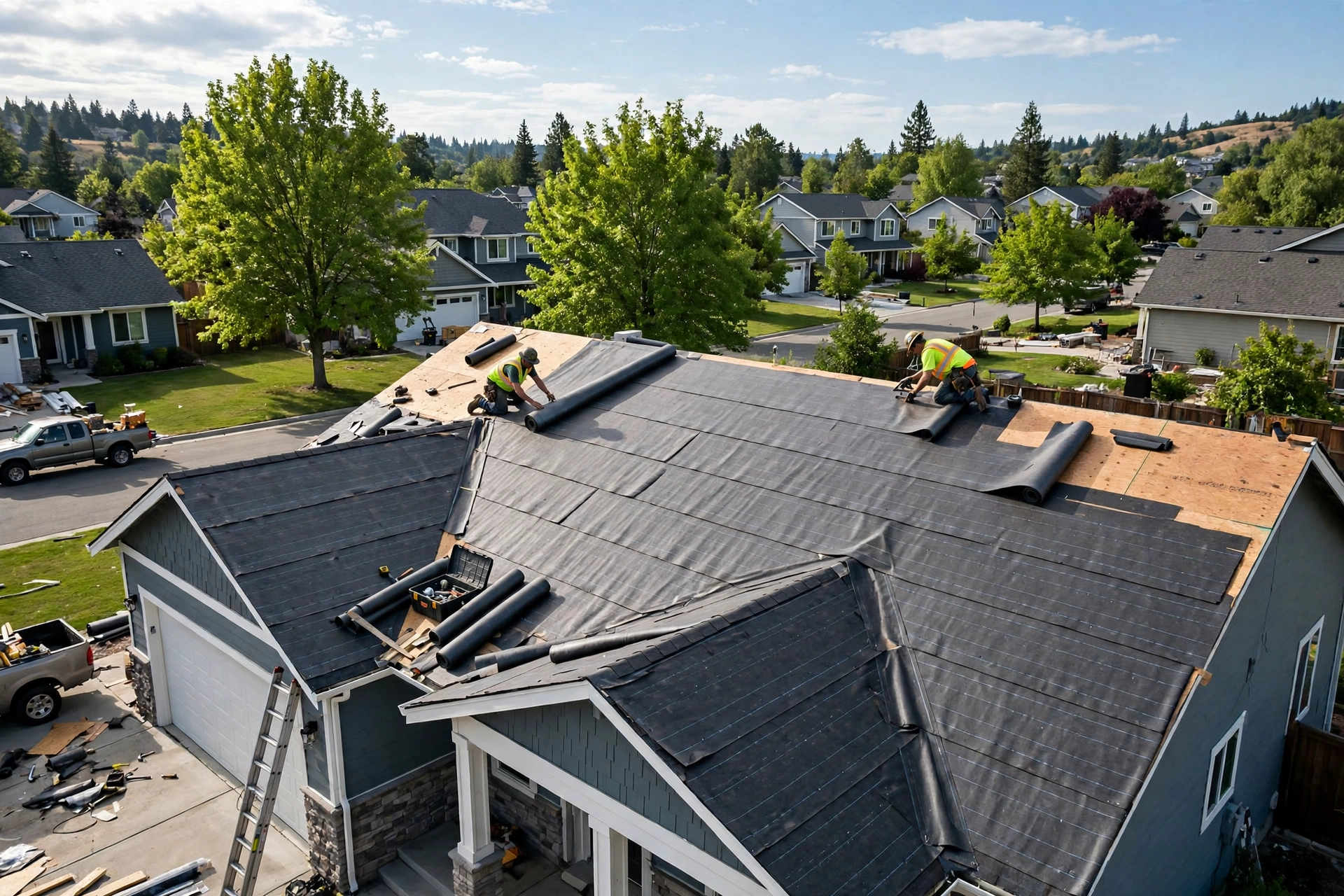
On a typical asphalt-shingle roof, the deck is usually plywood or oriented strand board. The underlayment is rolled across that deck in horizontal courses, starting at the eave and working upward so each upper course overlaps the one below it, like shingles themselves. At valleys, the membrane is often run down the valley first or reinforced with an additional layer, and around chimneys, skylights, vents, and pipes, flashing and membrane work together to close the joints where different materials meet.
Asphalt Felt Underlayment: Where the Old Standard Still Works and Where It Fails
Asphalt-saturated felt, often called tar paper, has protected roofs for generations. It is made by saturating an organic or fibreglass mat with asphalt, and it is sold by weight, most commonly as 15-pound or 30-pound felt. The heavier 30-pound version is thicker, stronger, and generally the better choice when felt is used at all, because it resists tearing during installation and handles foot traffic better than the lighter grade.
Its weaknesses are the reason it has lost ground. Felt wrinkles when wet, tears easily once nicked, and becomes slippery underfoot, which increases the risk to installers on steep slopes. It absorbs water over time rather than repelling it, and it degrades faster under prolonged ultraviolet exposure if a roof is left uncovered for weeks. Perhaps most importantly, felt does not seal around nail holes, so water that reaches a fastener can follow it into the deck. For a homeowner planning to keep a roof for decades, those weaknesses are worth weighing against the upfront saving.
Synthetic Roofing Underlayment: Why Most New Roofs Now Use It
Synthetic underlayment is made from woven or spun polymer fibres, often polypropylene, and it has become the standard field underlayment for many new residential roofs. It is lighter than felt, typically much stronger in tear resistance, and it repels rather than absorbs water. It also lies flatter, which helps shingles sit evenly, and many products offer a textured walking surface that improves grip for installers compared with wet felt.
Another practical advantage is exposure tolerance. A synthetic product can often remain exposed to weather for weeks or even months without the rapid deterioration felt suffers, which matters when a roofing project is delayed by rain, material deliveries, or inspections. That tolerance does not make it a permanent roof on its own, and manufacturers set exposure limits that should be followed, but it reduces the risk that a delayed project becomes a damaged deck.
Self-Adhering Ice-and-Water Membranes for Eaves, Valleys, and Roof Penetrations
A self-adhering membrane, commonly called ice-and-water shield, is a rubberised asphalt membrane with a sticky backing that bonds directly to the deck. Unlike felt or synthetic underlayment, it is waterproof and it seals around nail penetrations, which makes it the right tool for the places where water does not simply run downhill. Those places include eaves in cold climates, where ice dams can push meltwater uphill beneath shingles, valleys where two slopes concentrate runoff, and the edges around chimneys, skylights, vents, and pipes.
At eaves, the membrane should extend well past the inside face of the exterior wall, not merely to the edge of the overhang, because an ice dam can back water up beyond the overhang itself. In valleys, a continuous run of membrane gives water a sealed channel even when shingles or tiles in the valley are damaged. Around penetrations, the membrane is cut and folded carefully so water is directed onto, not under, the surrounding layers, and it is paired with flashing rather than used as a replacement for it.
Matching Roofing Underlayment to Slope and Concentrated Water Risk
Roof slope changes how hard water works against the system. On steep slopes, water runs off quickly and the main risk is wind-driven rain at laps and penetrations, so a strong synthetic field layer plus membrane at valleys and eaves is often sufficient. On low slopes, water moves slowly, pools more easily, and has more time to find seams, so wider laps, additional membrane, and stricter attention to drainage become more important. Very low-slope roofs may need a different roofing system altogether, and underlayment alone cannot make a steep-slope shingle system perform like a flat-roof membrane.
Underlayment Installation Details That Decide Whether Leaks Actually Stay Out
Installation details are where many underlayment failures begin, and they are also where a homeowner can ask the most useful questions. Courses should start at the eave and lap upward, with the lap width set by the manufacturer and the roof slope, not by guesswork. End joints, where one roll ends and another begins, should be staggered and lapped so water cannot run straight through a vertical seam. Fasteners should be placed in the lap zone where possible, so the upper course covers them, and capped nails or plastic-cap fasteners are often specified for synthetics because they spread the load and reduce tearing.
- Confirm the exact underlayment product and where each type will be used, not just a generic description.
- Ask how far ice-and-water membrane will extend at eaves, measured from the interior wall line.
- Check that laps run uphill-to-downhill, with end joints staggered and fasteners in the lap zone.
- Confirm that valleys, skylights, chimneys, and vents will receive membrane plus flashing, in the correct order.
Roofing Underlayment Errors That Let Water Past an Otherwise Sound Roof
One frequent error is treating underlayment as a single product for the whole roof, with no extra protection at valleys or eaves. The field may be perfectly installed, yet the first ice dam or valley storm finds the one place where a waterproof membrane was needed and not used. Another error is the reverse: covering the entire deck with self-adhering membrane on a roof with poor attic ventilation, trapping moisture and causing deck rot that only appears years later as soft spots or mould inside the attic.
Finally, reusing old underlayment during a re-roof is a false economy in most cases. Old felt may look intact when the shingles come off, but it has already aged, lost flexibility, and suffered nail holes from the previous roof. The cost of new underlayment is a small share of a full re-roof, while the cost of removing new shingles to fix a leak caused by old underlayment is very large. When a roofer proposes to reuse underlayment, ask for a clear reason tied to its condition and the covering type, not merely to save a day of labour.
What Roofing Underlayment Work Means for Your Budget in Broad Terms
Underlayment material is usually a modest share of a full roofing project, which is why upgrading it is often good value even when the overall roof budget is tight. As broad estimates only, and varying widely by region, roof complexity, and labour rates, felt is the cheapest material, synthetic underlayment costs somewhat more per square, and self-adhering membrane costs the most per square foot. Installed prices for a complete roof reflect labour, tear-off, flashing, and disposal as well, so the difference between felt and synthetic field underlayment is often smaller in the total quote than the material price gap suggests.
When a Roofing Underlayment Problem Needs a Licensed Roofer Rather Than a Repair
A licensed roofer can also advise when a localised repair is enough and when a larger section, or a full re-roof, is the honest answer. If underlayment has failed across a valley or a whole slope, patching shingles over it will not restore the backup layer. Similarly, if ice dams recur every winter, the problem may involve insulation and attic ventilation as well as underlayment, and a roofer who only replaces shingles may leave the underlying cause untouched. Permits and code requirements for re-roofing vary by location, so a contractor who is familiar with local rules is an asset, not merely a convenience.
Final Thoughts: Choosing Roofing Underlayment That Protects More Than Shingles
The best roofing underlayment choice is rarely the cheapest product or the most expensive one used everywhere. It is a combination: a strong, tear-resistant synthetic layer across the field, a waterproof self-adhering membrane where water concentrates or moves uphill, and careful installation that respects laps, valleys, and penetrations. That combination protects the deck, the framing, and the rooms below, long after the shingles themselves have aged. Before your next roof project, ask for the product names, the zones, and the installation details in writing, and keep that specification with your home records. It is the hidden layer you will never see again, but it is the layer that decides how much a future storm will cost you.
Roofing Underlayment FAQs
Can new shingles be installed over old roofing underlayment?
Usually not as a sound long-term choice. Old underlayment has aged, lost flexibility, and already contains nail holes from the previous roof, so reusing it leaves gaps in the backup layer. New underlayment is a small share of a re-roof cost, and replacing it now avoids removing new shingles later to fix a leak it caused.
Is synthetic underlayment waterproof?
No, synthetic underlayment is highly water-resistant, not fully waterproof. It sheds water running downhill very well, but it does not seal around fasteners. That is why self-adhering membrane, which does seal around fasteners, is used at eaves, valleys, and penetrations where water can stand or move uphill.
Where is ice-and-water membrane actually required?
Requirements vary by local code and climate, but it is commonly used at eaves in cold climates, in valleys, around chimneys and skylights, and at low-slope transitions. At eaves, it should extend past the interior wall line, because ice dams can push water beyond the overhang. Check local code and your roofer’s specification for your roof.
How long can roofing underlayment be left exposed to weather?
It depends on the product. Felt deteriorates relatively quickly when exposed to sun and rain, while many synthetics tolerate weeks or months of exposure within the manufacturer’s stated limit. Exposure limits are product-specific, so ask for the limit in writing and plan the project schedule around it rather than assuming any underlayment can wait indefinitely.
What are the signs that underlayment has already failed?
Common signs include water stains on ceilings or the underside of the roof deck, soft or discoloured decking in the attic, damp insulation, and mould on framing. A leak that appears far from the actual entry point is also common, because water can travel along the deck before dripping through. If you see these signs, have the roof and attic inspected promptly rather than only repainting the stain.