When you plan a home renovation, most of the carbon conversation revolves around the energy your home will use afterwards — better boilers, heat pumps, LED lighting. Yet every renovation carries a second, hidden carbon cost: the emissions locked into the materials themselves. This is embodied carbon — the CO₂ equivalent (CO₂e) released when materials are extracted, manufactured, and transported to your home. Understanding your home renovation carbon footprint means weighing both sides: the operational savings new materials deliver against the embodied emissions they bring.
- The short answer: in most renovations, reusing what is already in the house — the structure, sound timber, bricks, and serviceable windows — avoids far more carbon than any material swap. Renovation and reuse typically save 50–75% of embodied carbon compared with new construction, per the American Institute of Architects, because most embodied carbon sits in the structure. When replacement is unavoidable, insulation upgrades almost always repay their embodied carbon through lower heating demand; and when you do replace, choose lower-carbon options — cellulose or wood fibre over high-GWP foam boards, reclaimed over new, recycled-content steel over virgin.
What Makes Up a Home Renovation Carbon Footprint?
A renovation's carbon footprint has two parts. Embodied carbon covers everything emitted to make and deliver materials: extraction, manufacturing, transport, construction waste, and disposal. Operational carbon covers emissions from running the home afterwards — heating, hot water, lighting, appliances. Together they form the whole-life carbon footprint.
The scale is easy to underestimate. Construction accounts for roughly 37% of global emissions, and Circular Ecology puts the embodied carbon of an average new-build UK home at around 45 tonnes of CO₂e. A renovation spends far less — but unlike a new build, the structure already exists, so its carbon is already spent. That makes reuse the single most powerful lever you have.
How Renovation Carbon Is Actually Counted
Carbon accounting follows life-cycle stages: A1–A3 (extraction and manufacturing), A4–A5 (transport and construction), B4 (replacements during the building's life), B6 (operational energy), and C1–C4 (end-of-life). Manufacturers publish Environmental Product Declarations (EPDs) reporting these stages.
One rule matters most: compare materials per functional unit, not per kilogram. The ICE database gives sawn softwood at about 0.07 kgCO₂e/kg, concrete at about 0.10, and structural steel at about 2.38 — steel looks worst, yet a slender steel beam can use far less mass than the concrete alternative. Compare per square metre of wall, per window, or per complete element. You do not need life-cycle software; relative comparisons and a few rules of thumb capture most of the savings.
Reuse vs Replace: A Decision Framework
Think of renovation materials as a hierarchy, from lowest to highest carbon: keep in place, reuse on site, reclaimed materials, recycled-content products, new low-carbon products, and finally new conventional products.
When Keeping Is the Carbon Winner
Structure and foundations hold the largest share of a building's embodied carbon. A UCL life-cycle study of London homes found refurbishment at 1,100–1,500 kgCO₂e per square metre versus 1,220–1,850 for replacement — and noted reuse delivers emissions cuts faster. Keep sound masonry, timber frames, and roof structures wherever viable.
When Replacement Earns Its Carbon Cost
Replacement wins when the existing element is failing or so inefficient that its operational penalty dwarfs its embodied cost: single glazing upgraded to double glazing, degraded or contaminated insulation, asbestos-containing materials (health first), or a fossil-fuel boiler swapped for a heat pump. Rotten timber and water-damaged boards are legitimate replacements too — keeping a failing element stores up a bigger job, not carbon savings.
The Carbon Payback Question
Every replacement is an embodied-carbon investment repaid by operational savings. Additional insulation almost always pays back through lower heating demand, fastest where heating is carbon-intensive. One nuance: the time horizon matters — a Flemish wall-renovation study found some approaches looked poor over five years but excellent over sixty as savings accumulated.
Insulation: Keep, Top Up, or Replace?
Insulation is the most common reuse-versus-replace decision in a renovation, and one of the most consequential. Get it right and you bank large operational savings for a modest embodied cost.
Assessing What Is Already There
Existing insulation can usually stay if it is dry, fills its cavity, and has not slumped. Warning signs it is finished: visible voids in settled blown cellulose, batts compressed to half their thickness, water staining, pest contamination, or vermiculite that may contain asbestos. Lift a section and look — a ten-minute inspection beats a wrong guess.
Topping Up Beats Tearing Out
Where existing insulation is thin but sound, topping up is the carbon bargain of renovation. Blowing extra cellulose or mineral fibre over a loft layer adds little embodied carbon while cutting heat loss substantially. Check the structure can take the weight and keep eaves ventilation clear — trapped moisture undoes the benefit.
When Full Replacement Makes Sense
Strip out and replace when insulation is contaminated, water-damaged, or the wrong product in the wrong place — such as absorbent batts against damp masonry. Dispose of removed material responsibly through take-back or recycling schemes where available, or licensed disposal for contaminated material.
Choosing Lower-Carbon Insulation
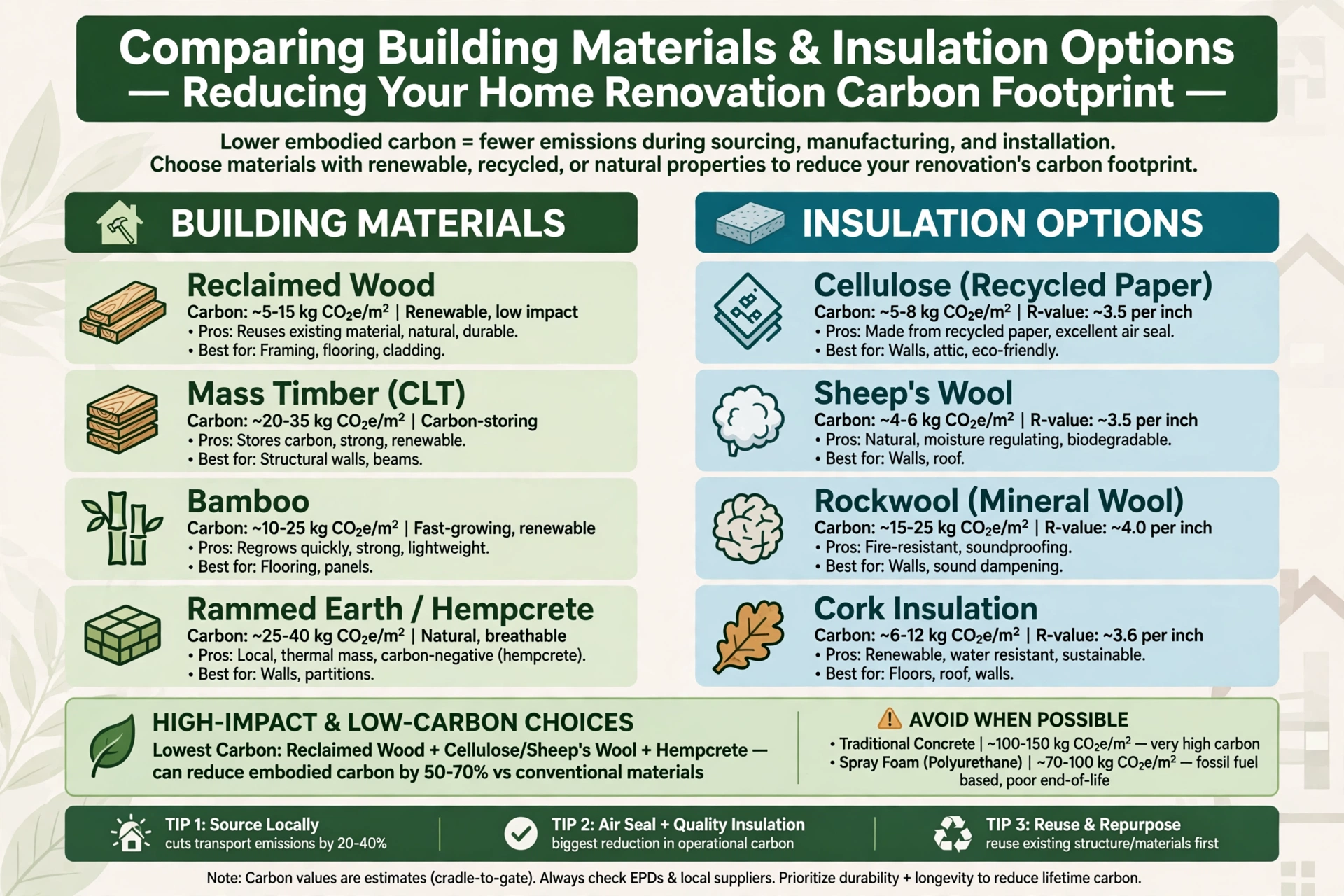
When buying new, the carbon spread is enormous. Per 100 m² at equal thermal resistance, published figures put XPS foam near 4,900 kgCO₂e, EPS around 290, sheep wool near 115, and hemp or wood fibre at negative values — they store more carbon than production emits. Project Drawdown estimated that switching that area to cellulose avoids about 1.59 tonnes of CO₂e over a century (over 4 tonnes on a twenty-year view), because foam blowing agents are potent greenhouse gases. These high-GWP blowing agents are being phased down under the Kigali Amendment but remain common today. One caveat: never trade a large loss of thermal performance for a small embodied gain.
*Indicative figures from published life-cycle studies; values vary by manufacturer and blowing agent.
Element-by-Element Reuse Decisions
Windows
Repair plus secondary glazing can approach double-glazing performance at a fraction of the embodied cost. A life-cycle study found maintenance generally preferable, with replacement winning only where originals were very poor and heating carbon-intensive. Upgrading single glazing (around 5.2 W/m²K) to modern double glazing (around 1.2) is usually justified; replacing decent double glazing rarely is.
Kitchens and Bathrooms
Reuse carcasses and replace only doors and worktops — refacing avoids most of a kitchen's embodied load. Offer sound removed units for reuse rather than skipping them. For appliances, operational carbon dominates: keep efficient models and replace genuine energy hogs.
Structural Timber
Reclaimed beams avoid the entire production chain — felling, milling, drying, transport. Have reclaimed structural timber graded and get an engineer's sign-off before it carries loads.
Bricks and Masonry
Reclaimed bricks carry almost no new carbon. A Tunley Environmental analysis found that for 15,000 bricks (around 30 tonnes), reclaimed stock came in at −0.10 tonnes CO₂e versus 6.39 for new — a saving of about 6.49 tonnes, roughly twenty years of an average home's electricity emissions. Bricks bedded in lime mortar can be cleaned and reused; cement mortar makes that far harder.
Flooring
Solid timber floors can be sanded and refinished several times at a fraction of replacement carbon. Where boards are beyond saving, reclaimed boards match better than new timber and avoid fresh production emissions.
When You Must Replace: Lower-Carbon Material Choices
Metals
Virgin steel can carry roughly five times the embodied carbon of high-recycled-content steel, per the American Institute of Architects — always specify recycled content. Extruded aluminium can exceed 30 kgCO₂e per kg, so use it sparingly and reuse existing metalwork wherever possible.
Concrete and Masonry
Concrete is moderate per kilogram but used in such volume that it often dominates a project's total. Retain existing concrete and masonry; where new is needed, choose lower-carbon mixes (for example with GGBS cement replacement) and avoid over-specifying strength.
Timber
Timber can be carbon-negative: the tree absorbs CO₂ as it grows and it stays locked in while the timber stands. Choose certified (FSC/PEFC), locally sourced timber — and never burn waste timber, which releases the stored carbon straight back to the atmosphere.
Plasters and Finishes
Lime plaster generally carries lower embodied carbon than cement-based alternatives, stays breathable on traditional walls, and allows future deconstruction. Standard gypsum plasterboard sits mid-range — acceptable, but compare against lime where the build-up suits it.
*Indicative cradle-to-gate factors from the ICE database and EPD compilations.
How to Estimate Your Project's Carbon Cost
You do not need specialist software to get a useful answer. Work through these steps before buying materials:
List everything you plan to buy — type and approximate quantity. Big-ticket items (structure, insulation, glazing, metals) matter most.
- Note everything you will keep or reuse. That is carbon you do not spend.
- Look up indicative embodied-carbon factors from EPDs or published database summaries.
- Multiply quantity by factor for the major items — ranking matters more than precision.
- Compare options directly — reclaimed versus new, cellulose versus XPS — and choose the lower whole-life total.
- Sanity-check the payback: will energy savings repay the embodied cost within the material's service life?
Common Mistakes That Raise a Renovation's Carbon Footprint
- Ripping out a serviceable kitchen or bathroom for purely cosmetic reasons.
- Choosing high-GWP spray foam where blown cellulose or wood fibre would perform.
- Replacing windows that could be repaired, draught-proofed, and fitted with secondary glazing.
- Over-specifying concrete strength or steel sections beyond structural need.
- Landfilling reusable timber, bricks, and fixtures instead of salvaging them.
- Ignoring transport — local reclaimed usually beats an imported 'eco' product.
- Fixing materials together in ways that prevent future reuse.
Safety and When to Call a Professional
Carbon thinking must never override safety. Treat old insulation, textured coatings, or pipe lagging as possible asbestos until a licensed survey says otherwise. Assume pre-1978 paint may contain lead. Structural alterations need a structural engineer; gas and electrical work belongs to qualified tradespeople. Always fix the source of damp or mould before adding insulation.
Final Thoughts
The lowest-carbon renovation is rarely the one with the greenest new materials — it is the one that buys the fewest new materials. Start with a reuse inventory: list what can stay, what can be repaired, and what can be reclaimed before pricing a single new product. Then spend your carbon budget where it pays back — insulation, airtightness, efficient heating — and choose lower-carbon options for whatever must be replaced.
Frequently Asked Questions
What is embodied carbon in a home renovation?
The greenhouse gas emissions to make and deliver building materials — extraction, manufacturing, transport, construction, and disposal. The 'upfront' carbon cost of every new product, measured in kgCO₂e.
Does reusing old materials really save carbon?
Yes — substantially, because reuse avoids the entire production chain. The American Institute of Architects reports renovation and reuse typically save 50–75% of embodied carbon versus new construction, since the most carbon-intensive parts are kept.
Should I replace my old insulation or top it up?
Top it up if the existing layer is dry, fills its cavity, and has not slumped — topping up adds little carbon for a large energy gain. Replace only if it is contaminated, water-damaged, or the wrong product for the location.
Is it better to repair or replace old windows to save carbon?
Repair is usually lower-carbon: overhauling sashes, draught-stripping, and secondary glazing can approach double-glazing performance. Replacement is justified for single glazing in very poor condition, where energy savings repay the cost.
Which insulation has the lowest carbon footprint?
Wood fibre, hemp, and cellulose are lowest and can store more carbon than production emits. Sheep wool is also low; mineral wool sits mid-range; XPS, PUR, and PIR foams are highest, due to high-GWP blowing agents.
How do I compare the carbon footprint of two materials?
Compare per functional unit — per square metre of wall or per complete element — not per kilogram. Multiply quantity by an indicative embodied-carbon factor, then add operational carbon over the service life.
When is replacing better than reusing?
When the existing element is failing, unsafe, or so inefficient its operational penalty outweighs replacement carbon — for example, single glazing upgraded to double glazing, degraded insulation, asbestos-containing materials, or a fossil-fuel boiler swapped for a heat pump.