In a narrow bedroom, the closet door is often the first thing that starts fighting back. The bed sits close to the closet wall, the walkway is tight, and a door that swings outward either hits furniture or cannot open far enough to reach the clothes inside. The right door style decides whether the closet is genuinely usable every day or merely looks finished in photographs.
- The short answer: In a narrow bedroom, bypass sliding doors and pocket doors save the most floor space because they never swing into the room, while bifold doors offer the best balance of full-width access and a small footprint. Hinged doors only make sense when clear swing room exists to spare, and barn-style sliders only work when an empty stretch of wall sits beside the opening. The right choice comes down to three measurements: the floor space in front of the closet, the wall space beside it, and the clear opening width a person needs to reach inside comfortably.
Why a Narrow Bedroom Punishes the Wrong Closet Door First
Every closet door style pays for its opening in a different currency. Hinged doors pay in floor space, since the panel sweeps an arc equal to its full width into the room: a standard 30-inch door needs roughly 30 inches of clear floor in front of it. Bypass sliders pay in access, exposing only about half the closet at a time, while bifold panels fold back and project roughly a third to a half of their width into the room, yet reveal nearly the whole closet once open.
Accessibility adds a second test. A comfortable clear opening for a walker or wheelchair is generally at least 32 inches wide, and the floor in front of the closet should stay level, without a raised threshold to trip over or catch a wheel.
Bypass Sliders: The Zero-Swing Workhorse for Tight Bedrooms
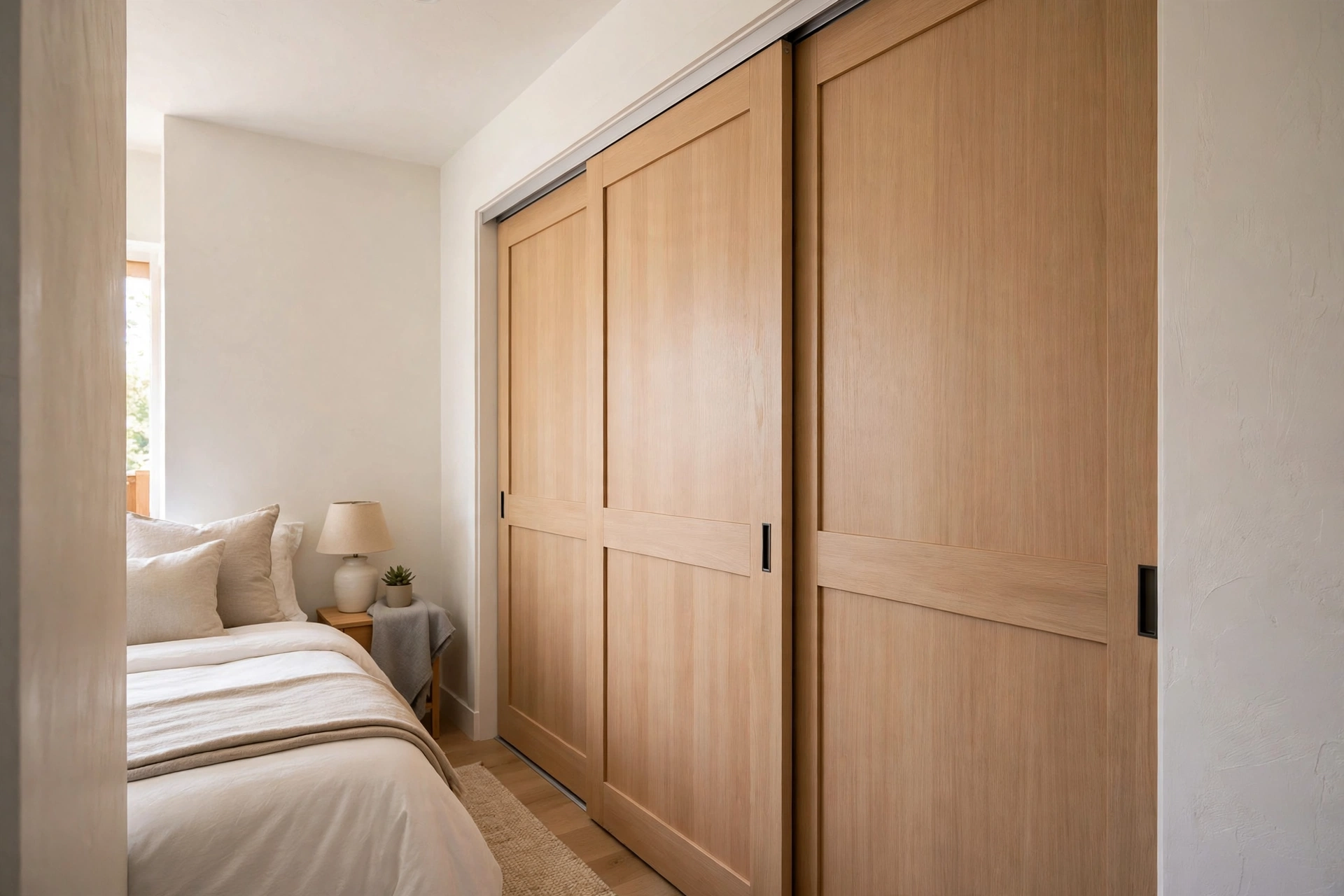
Bypass sliding doors are the default answer for narrow bedrooms because they take up no floor space at all. Two or more panels run on parallel tracks, one sliding behind the other, so furniture can sit right up against the closet and the walkway stays clear.
The trade-off is access: with a standard two-panel bypass door, only one side of the closet is open at any moment. Three- and four-panel systems soften this on wide openings, and mirrored panels can make a small bedroom feel larger. Bypass doors are also easy to operate, a light panel on a clean track needs only a gentle push, and a wide D-shaped pull is far easier to grip than a small round knob. The weak point is maintenance: tracks collect dust, and a panel that drags or jumps its track quickly becomes harder to move than any hinged door.
Bifold Panels: Full-Width Access With Half the Swing
Bifold doors are the compromise many narrow bedrooms end up with, and it is a good one. Each side of the opening is a pair of panels joined by a center hinge, so the panels fold flat against each other as they open, projecting only a fraction of their width into the room. Once open, bifolds expose nearly the entire closet, which makes them the best choice when full visibility matters more than absolute floor savings.
That full access shows up in daily use: getting dressed or reaching the back corner of a shelf is noticeably easier when the whole opening stands open instead of half of it. Bifolds suit standard reach-in closets and come in affordable stock sizes, which keeps purchase and installation simple. They do need a little more care than sliders, since the folding action depends on pivots, hinges, and a top track staying in alignment, and a frame that is out of square will make panels bind.
Pocket Doors: The Vanishing Option When the Wall Allows It
A pocket door is the only closet door that costs nothing in floor space and nothing in visible wall space: open it, and the panel slides entirely into a cavity inside the wall. For the tightest bedrooms, that disappearing act is hard to beat, and it leaves the full closet opening clear, a genuine accessibility advantage.
The catch is the wall itself. A pocket door needs a hollow cavity at least as wide as the door panel beside the opening, so the wall cannot be load-bearing without structural work, and it cannot already hold plumbing, wiring, or ductwork in that bay. That is why pocket doors are easiest during a remodel and hardest as a quick swap, and why installed cost estimates run higher than a simple bifold or bypass replacement. The track and rollers also live inside the wall, so a sticking pocket door is harder to adjust.
Barn Sliders and Hinged Pairs: Where They Fit a Narrow Layout
Barn-style sliding doors deserve a harder question than style in a narrow bedroom. A barn door hangs from a rail on the wall face, so it needs a clear stretch of wall beside the opening at least as wide as the door itself. Where that wall is taken by a bed, a dresser, or a light switch, the barn door has nowhere to go. Where the wall is free, a barn slider works like a bypass door with a bolder look, and a top-hung rail keeps the floor clear.
Hinged doors, including French-style pairs, are the worst fit for most narrow bedrooms and the best fit for a few. A hinged door needs its full width clear in front of it, which is exactly what a tight room cannot offer, but hinged doors give complete access, are the most durable and lowest-maintenance option, and are the easiest to operate with a lever handle. If the swing area is genuinely free, a hinged door is a perfectly good choice.
How the Seven Closet Door Styles Compare in a Narrow Bedroom
The table below compares the main styles on the factors that matter most in a tight layout: room needed to open, closet access, accessibility, and installed cost. Costs are broad estimates only.
Read the table with your own room in mind rather than as a ranking. A bypass slider wins on floor space but loses on access, a bifold wins on access but needs a little swing room, and a pocket door wins on both but only when the wall cooperates.
Measuring a Narrow Closet Opening So the New Door Actually Fits
Most closet door disappointments start with measuring, not with the door itself. Closet openings are frequently not perfectly square, and stock doors are built to standard sizes, so measuring in the wrong place can leave a panel that binds, gaps, or will not hang at all. Take these steps before ordering anything:
Measure the width in three places, top, middle, and bottom, and use the smallest number, since the door must clear the tightest point.
Measure the height on both sides and in the center, keeping the smallest figure, and note the finished floor height if new flooring is planned.
Check the opening for square by comparing diagonal measurements; a difference of more than a small fraction of an inch warns that a bifold or pocket door may bind.
Measure the floor space in front of the closet and the clear wall beside it, since these two numbers rule hinged and barn doors in or out.
Measure the clear opening width with the door open, aiming for at least 32 inches of genuinely usable passage for accessibility.
Note anything inside the wall beside the opening, such as switches, outlets, or vents, which can block a barn rail or a pocket cavity.
If the opening falls between stock sizes, a custom slab or a trimmed solid door can bridge the gap, but hollow-core doors can only be cut a small amount before the internal frame is exposed.
Hardware That Makes Any Closet Door Easier to Open
The door style gets the attention, but the hardware decides how the door feels every single day. Lever handles beat round knobs for anyone with limited grip strength, since a lever can be pushed down with a palm or elbow rather than twisted. On sliding and bifold doors, a wide D-shaped pull gives the whole hand something to hold.
Soft-close tracks are a worthwhile upgrade on bypass and bifold systems: they stop panels from slamming and make the door feel solid rather than rattly. Ball-bearing rollers on a quality aluminum track are another quiet upgrade, carrying heavier panels smoothly for longer than basic plastic wheels. Keep the threshold flush with the floor, since even a small raised strip becomes a trip edge, and vacuum the track every few months.
Closet Door Slip-Ups That Steal Back the Space You Just Saved
The most common mistake is choosing a door for its photograph rather than its footprint. A barn door mounted over a wall that holds the light switch, or a hinged pair that cannot open past the bed, returns every inch the new door was supposed to save. Sketch the swing arc or slide path on the floor with tape before buying.
Bedroom Closet Door Questions Narrow-Layout Homeowners Ask Before Buying
Which closet door saves the most space in a very small bedroom?
A pocket door saves the most, because it takes no floor space and no visible wall space when open. If the wall cannot hold a pocket, a bypass sliding door is the next best space saver, though it only opens half the closet at a time.
Can a wheelchair user comfortably use a bypass sliding closet door?
Often yes, provided the clear opening is at least 32 inches wide, the track is flush with the floor, and the panel glides lightly on a clean track with a wide D-shaped pull. Only one side opens at a time, so everyday items should sit on the side that opens most easily.
Do bifold closet doors really open the whole closet?
Nearly, yes. A bifold set folds back to expose almost the full opening, which is why it beats a bypass slider for visibility. A small stack of folded panels stays at the edges, so the usable width is slightly less than the full frame, but the difference is small in most standard closets.
Is a pocket door a bad idea in an older home?
Not necessarily, but older walls are more likely to hide surprises: plaster and lath instead of drywall, unexpected wiring or plumbing in the bay, and walls that carry structural load. Checking what runs through the wall should come before any pocket door kit is bought.
Why does my sliding closet door keep jumping off its track?
The usual causes are a dirty or bent track, worn rollers, or a floor guide that has shifted. Cleaning the track, tightening the roller adjustments, and replacing worn wheels usually fixes it. For a heavy or mirrored door, ball-bearing rollers on a sturdier track prevent the problem from returning.
Can I replace a hinged closet door with a sliding one without reframing?
In many cases, yes, if the opening is a standard size and the new track fits the existing header. Bypass and bifold kits are made for exactly this swap. A pocket door is the exception, since it needs a new wall cavity, and a barn door needs a solid rail mounting surface above and beside the opening.
Picking the Closet Door Your Narrow Bedroom Will Live With
Start from the room, not the catalogue. Measure the floor in front of the closet, the wall beside it, and the clear opening you actually need, then let those three numbers narrow the field. If floor space is scarcest, a bypass slider or pocket door leads. If full access matters most and a little fold room exists, a bifold leads. If the wall beside the opening is free and the look matters, a barn slider earns its place. Whichever style wins, spend the extra attention on hardware: a lever or D-shaped pull, a smooth track, and a flush threshold do more for daily ease than any panel material. When the wall itself must change, for a pocket cavity or a widened opening, bring in a carpenter rather than opening the wall twice.