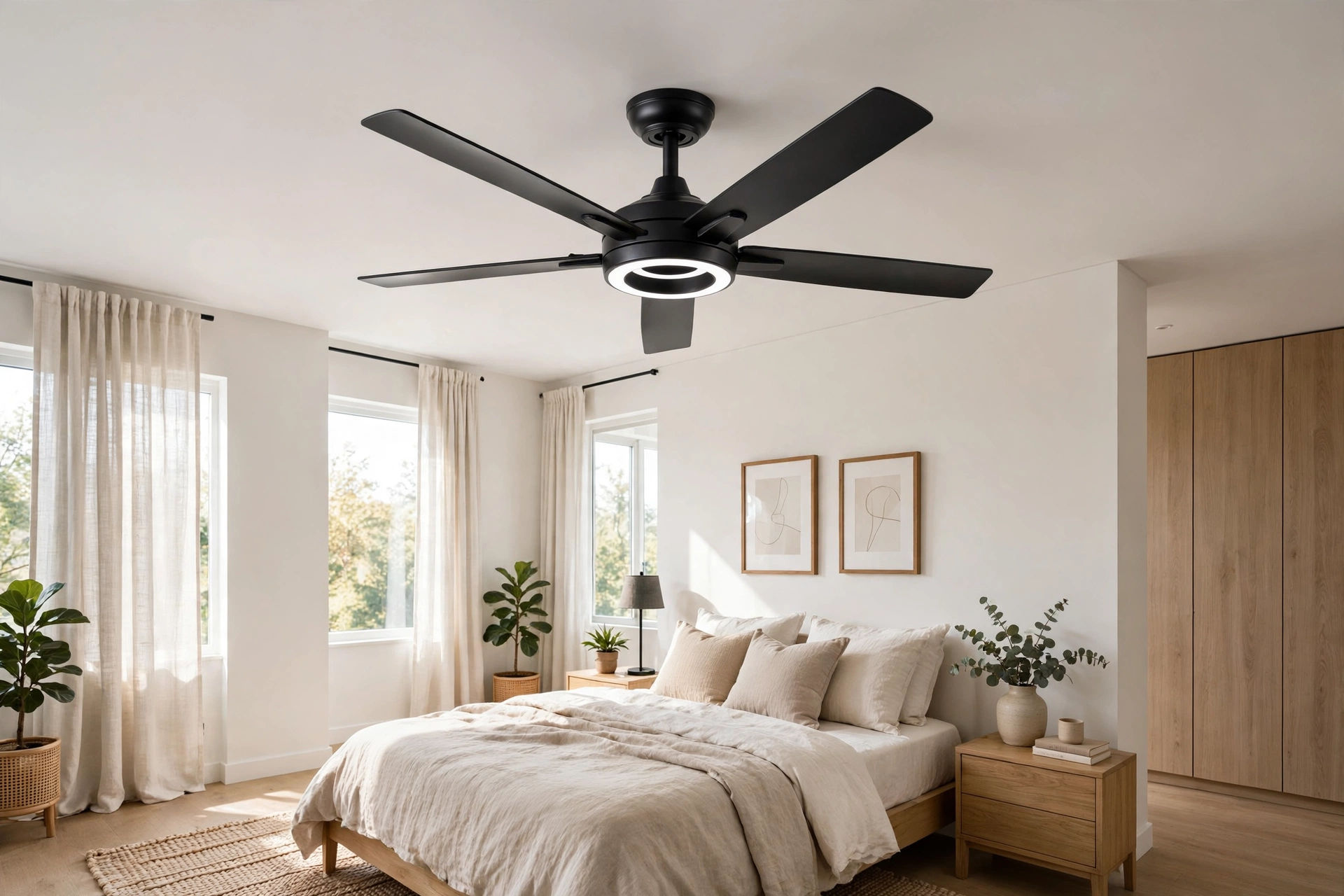
A bedroom ceiling fan should be the appliance you forget is running. Installed well, it keeps the room cooler, stops the air from feeling stale, and never disturbs sleep. Installed badly, the same fan clicks once per rotation, hums at low speed, or wobbles just enough to keep a light sleeper awake. The difference is rarely the brand on the box. It comes down to the right size, height, mounting box, blade balance, and a motor and speed setting suited to a bedroom.
The short answer: choose a fan sized to the bedroom, hang its blades 8 to 9 feet above the floor with at least 18 inches of clearance from the walls, mount it to a fan-rated ceiling box, and run a quiet DC motor on a low or medium speed rather than forcing a small fan to spin fast. A larger fan turning slowly moves more air with less noise than a small fan straining at full speed.
Why a Bedroom Fan Sounds Loud When the Room Feels Still
Noise and weak airflow often arrive together because they share the same causes. A fan hugging the ceiling cannot draw air freely, so it recirculates warm air near the ceiling while the bed below stays still. A fan crammed into a corner chops the air unevenly and pulses. A fan on an ordinary light-fixture box instead of a fan-rated box sends every vibration into the ceiling, which acts like a sounding board at night.
- Loose blade screws or brackets tapping once per rotation, producing a click or tick.
- Unbalanced blades from dust buildup or a warped blade, causing wobble and a low rumble.
- A loose canopy or light kit rattling as the motor vibrates.
- An incompatible wall dimmer controlling an AC motor fan, causing a hum no tightening will fix.
- A pull chain tapping the light shade or trim vibrating against the housing.
Sorting the sound by type points at the fix. Clicking once per revolution is almost always a loose or unbalanced blade, while a steady hum at every speed usually traces to the motor control or the mounting.
Matching Blade Span to Bedroom Size Before You Touch a Screwdriver
Blade span, the diameter of the circle the blades sweep, should be chosen from the room's dimensions. Too small a span leaves dead corners where air never moves. Too large a span pushes air straight into the walls, creating turbulence and noise. As a widely used guide, bedrooms up to about 75 square feet suit a 29 to 36 inch fan, standard bedrooms between 75 and 175 square feet suit a 42 to 48 inch fan, and larger bedrooms up to about 350 square feet suit a 52 to 56 inch fan.
CFM, or cubic feet per minute, measures how much air the fan moves, and it matters more than blade count or advertised speed settings. For a bedroom, also compare CFM per watt: a fan with a strong CFM-per-watt figure cools the room on low speed, which is exactly where a bedroom fan spends most of its life.
Hanging the Fan Where the Air Actually Reaches the Bed
Safety standards require the lowest point of the blades to sit at least 7 feet above the floor, but the comfort zone is 8 to 9 feet, which puts the moving air in the occupied part of the room rather than near the ceiling. On a standard 8-foot ceiling that usually means a flush-mount or hugger fan. On a 9-foot ceiling, a short downrod drops the blades into the airflow zone. On ceilings of 10 feet or more, a longer downrod, often 12 to 24 inches, brings the fan down to where it can be felt. Keep blades at least 18 inches from the nearest wall, and use the manufacturer's slope adapter on a sloped ceiling. Where a bunk bed stands in the room, measure clearance from the top of the mattress, not just from the floor.
DC or AC: Which Bedroom Motor Hums Less at 2 a.m.
The motor decision is the one most likely to decide whether the fan is audible at night. Traditional AC motors are cheaper, but they tend to hum, especially when controlled by a wall dimmer or run at low speed. DC motors run cooler, use substantially less electricity, and are generally the quieter choice, with many models rated under 30 decibels on low speeds. They also offer more speed steps, often six or seven instead of three, so you can find a gentle setting between too still and too breezy.
If you already own an AC fan that hums, check the wall control first: standard light dimmers should never control a fan motor, so replace the dimmer with a standard switch or a fan-rated control before blaming the motor. If the hum survives that change and the mounting is solid, a DC replacement is usually the lasting fix.
A Step-by-Step Quiet Install, From Fan-Rated Box to First Spin
A quiet fan is mostly installed before it is ever switched on. Turn the power off at the breaker, not just the wall switch, and verify with a non-contact tester before touching any wiring.
Confirm a fan-rated ceiling box. It must be metal, marked for fan support, and rated for the fan's weight, typically 50 to 70 pounds.
Assemble on the floor, then hang. Attach the blades to their irons on a flat surface so each blade sits at the same angle; a blade at a different pitch will fight the air and hum.
Set the downrod for 8 to 9 feet of blade height. Measure from the floor to the lowest blade edge after hanging, and adjust the rod before the canopy goes on.
Tighten in stages, then check again. Snug the bracket, canopy, blade, and light-kit screws, run the fan for a few minutes, then re-tighten.
Balance before you finish. Run the fan on medium; if the blades wobble, use the balancing kit, clipping the weight to one blade at a time until the wobble stops, then fix the adhesive weight in that spot.
Test every speed in silence. Run each speed for a minute and listen for clicks, hums, or rattles. Fixing a noise now, while the ladder is still out, beats diagnosing it at midnight.
One small detail pays off: where the manufacturer supplies a rubber washer or vibration pad, fit it between the mounting bracket and the ceiling box to damp the vibration path into the ceiling.
Blade Pitch, Blade Count, and Why More Blades Do Not Mean More Breeze
Blade pitch, the angle of the blade relative to the motor, is the specification that matters most: a pitch of about 12 to 15 degrees moves air efficiently without overloading the motor. Flatter blades slice through the air without moving much of it, which is why some cheap fans spin fast yet cool poorly, while steeper blades strain a weak motor, which then hums. Blade count, by contrast, is mostly a style choice. Three, four, or five blades can all move plenty of air for a bedroom when span, pitch, and motor are right, and extra blades add weight a marginal mounting box must carry. Judge the fan on span, pitch, CFM per watt, and motor type instead.
Silencing a Fan That Clicks, Hums, or Wobbles After Install
Even a careful install can develop a sound as screws settle and dust gathers. Work through the causes in order of simplicity, and stop at the first fix that works.
- Clicking once per rotation: tighten every blade and bracket screw, then check for a pull chain tapping the shade.
- Wobble: clean the tops of all blades, since uneven dust adds uneven weight, then use a balancing kit to find the heavy blade.
- Rattle from the light kit: tighten the shade screws and confirm each bulb is seated.
- Steady hum: confirm no light dimmer controls the fan, tighten the motor housing screws, and check the canopy is not vibrating against the ceiling.
- Canopy or ceiling box movement: stop using the fan and have the mounting inspected. A moving box is a safety issue, not a maintenance task.
A fan that grinds, smells of burning, or trips a breaker is telling a different story: worn bearings, a failing capacitor, or a cracked housing are not fixed by balancing, and on a fan more than about a decade old, a quiet DC replacement usually costs less than a major repair.
What a Quiet Bedroom Fan Install Tends to Cost, in Rough Terms
Costs vary by region and by how much electrical work the room needs, so treat every figure here as a broad estimate rather than a quote. A good-quality DC bedroom fan typically costs more upfront than a basic AC model, but the difference is often recovered through lower running costs over several years of nightly use. Where a fan-rated box and wiring are already in place, a straightforward swap is a modest job, while a new fan-rated brace, circuit, or wall control raises the cost with the electrical work.
When a Bedroom Fan Job Belongs With a Licensed Electrician, Not a Ladder and a Video
Many bedroom fan swaps are reasonable DIY work for a confident homeowner, but several situations belong with a licensed electrician. Call one in if there is no fan-rated box, if new wiring or a new circuit is needed, if the existing wiring is old, damaged, or ungrounded, or if the ceiling box moves when the fan wobbles. The same applies on a sloped or unusually high ceiling, when the breaker trips, or when any burning smell or sparking appears. A fan that falls because its box was never rated for it can cause serious injury.
Bedroom Ceiling Fan Installation Questions Homeowners Ask Before Drilling
How high should a bedroom ceiling fan hang above the floor?
Blades should sit at least 7 feet above the floor for safety, and 8 to 9 feet is the comfort zone for airflow. On an 8-foot ceiling that usually means a flush-mount fan; on higher ceilings, choose a downrod that lands the blades in that band.
Is a DC ceiling fan really quieter than an AC fan in a bedroom?
In most cases, yes. DC motors run cooler and avoid the electromagnetic hum AC motors can produce, especially at low speed or on an incompatible control. They also offer more speed steps, so you can find a genuinely gentle setting for sleep.
Why does my new bedroom fan wobble even though the blades look straight?
Wobble usually comes from uneven blade weight or a blade sitting at a slightly different angle, not from visibly bent blades. Clean the blades, tighten all blade screws, and use a balancing kit to find the heavy blade. If the canopy or ceiling box itself moves, stop using the fan and have the mounting inspected.
Can I install a bedroom ceiling fan on a sloped ceiling without extra noise?
Yes, with the manufacturer's slope adapter and the same clearances as a flat ceiling: blades 8 to 9 feet above the floor and at least 18 inches from walls and slopes. The adapter keeps the downrod vertical so the blades sweep level, preventing uneven airflow that causes pulsing noise.
Should a bedroom fan blow downward or upward in summer?
Downward, which means counterclockwise when viewed from below. That direction pushes a cooling breeze over the bed. In winter, reverse to clockwise on low speed to recirculate warm air without creating a draft.
What is the quietest speed setting for sleeping with a ceiling fan on?
The lowest speed that still moves air across the bed, often low or the second-lowest setting on a DC fan. If your fan has a sleep or natural-wind mode, use it: the gentle variation is less noticeable through the night than a constant drone at one speed.
The Bedroom Test: A Fan You Forget Is Running
Judge the finished job by a simple test: stand in the bedroom doorway at night with the fan on its usual sleep setting and listen for thirty seconds. If you hear clicking, humming, or rattling, something in the install still needs attention. If all you notice is cooler, fresher air without a draft, the installation details have done their job, and the fan will circulate air so quietly that sleep is never interrupted.