A south-facing living room can feel like a greenhouse by mid-afternoon, even with the air conditioning running. Interior blinds and curtains help with glare, but they sit inside the glass, which means the sun’s heat has already entered the room before they can do anything about it. The room stays warm, the cooling system works harder, and the blinds themselves radiate heat back into the space.
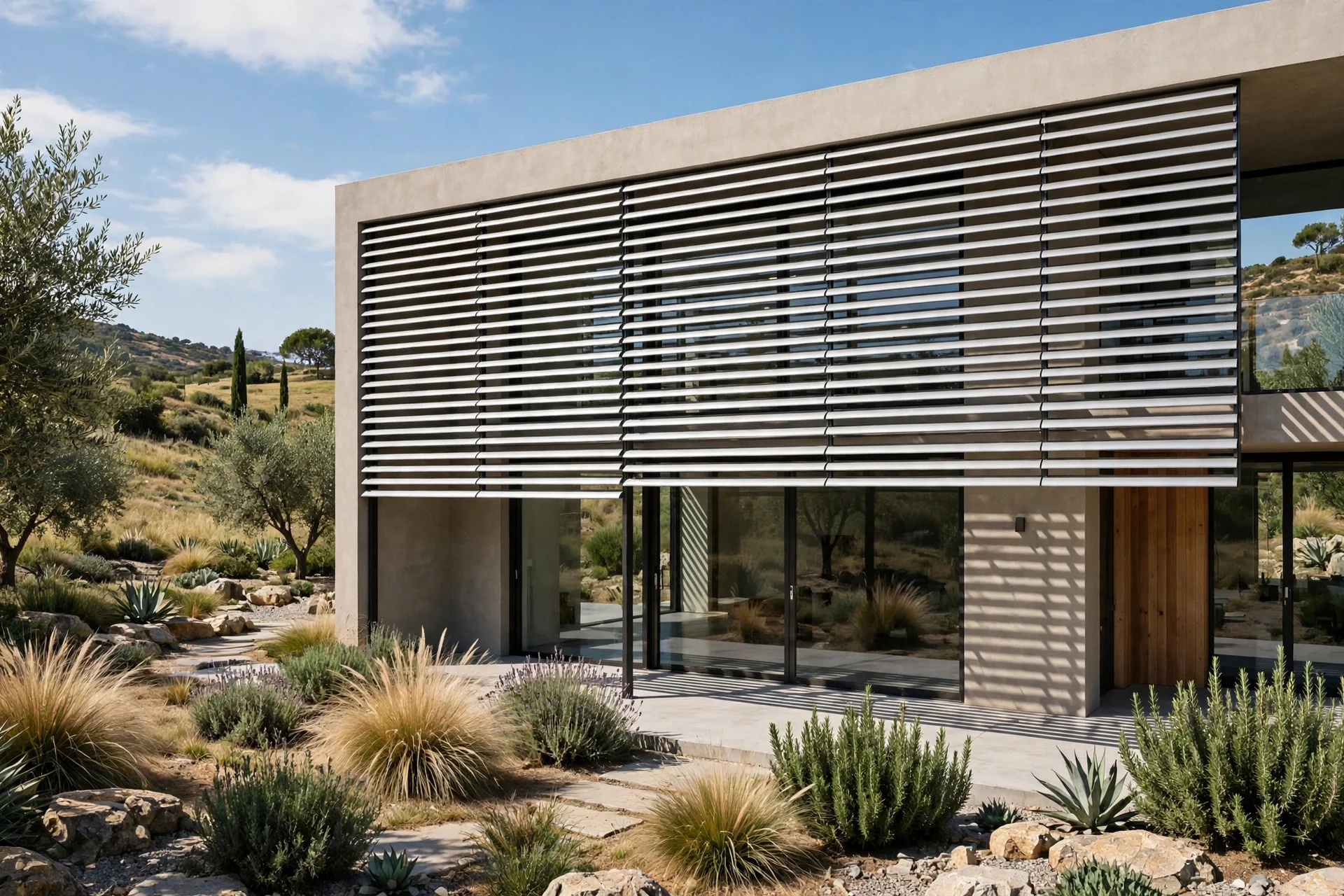
The direct answer is to stop the sun before it reaches the glass. Modular exterior sun louvers mount outside the window, where angled blades intercept direct sunlight and turn it away while still admitting diffused daylight and fresh air. Add a small motor and a sun sensor, and the blades adjust themselves through the day and the seasons, blocking summer heat and welcoming winter sun without anyone touching a switch.
Why Exterior Louvers Beat Interior Blinds at Cutting Solar Heat
The physics is simple: heat stopped outside the building never becomes a cooling load, while heat stopped inside already has. An interior blind absorbs sunlight that has passed through the glass, warms up, and releases much of that heat into the room. Manufacturers of exterior shading report that well-designed louver systems can intercept up to around 80 percent of direct solar radiation before it reaches the glass, cutting the solar heat gain coefficient of the window assembly substantially.
Exterior louvers also protect the window itself. The blades still admit daylight, because they are angled rather than solid, so rooms stay bright without the harsh glare that forces people to close curtains in the middle of the day. The result is a room that is cooler, brighter, and cheaper to keep comfortable than the same room with interior shading alone.
How Automated Sun Louvers Track the Sun Through the Seasons
The sun follows a different path in every season, and that is what makes adjustable louvers so effective. In summer the sun rides high, so nearly closed horizontal blades block it completely while still letting in soft, reflected light. In winter the sun sits low, so the same blades opened wider admit its warmth deep into the room, supporting passive solar heating. A fixed overhang can only be tuned for one season; an adjustable louver adapts to all of them.
Automation does the adjusting for you. A sun sensor or a small controller tracks the time of day and the season, rotating the blades to the angle that blocks direct sun while preserving the view. More advanced systems add temperature and wind sensors, and link to a smart home hub or building management system, so the louvers respond to the actual conditions on the facade rather than a fixed schedule.
Fixed, Manual, and Motorized Louver Modules: Which Layout Fits Your Facade
Modular louver systems come in three operating styles, and the right choice depends on the size of the facade, how hard it is to reach, and how much the owner wants to spend. Fixed blades are set once at a calculated angle and never move; they are cheap, silent, and maintenance-free, but they cannot adapt to seasonal sun angles.
| System type | How it adjusts | Best suited for | Relative cost |
|---|---|---|---|
| Fixed blades | Set once at installation | Small windows, tight budgets | Lowest |
| Manual crank or lever | Owner adjusts by hand | Reachable windows, patios | Low to moderate |
| Motorized, remote control | Motor, remote or wall switch | Large or high facades | Moderate to high |
| Automated, sensor-driven | Sun, wind, and temperature sensors | Whole-facade solar management | Highest |
Motorized systems are the natural partner for automation, using a low-voltage motor and a linkage that rotates every blade in a module together. They can be controlled by remote, wall switch, smartphone app, or a home automation system, and they are the only practical choice for large or high facades where manual adjustment would need a ladder.
Sizing Blade Angles and Spacing for Your Windows and Orientation
Blade angle is the whole design, and it starts with the sun path for your latitude and the orientation of each window. Horizontal blades suit south-facing windows, where the summer sun is high and the winter sun is low: a blade angle near 45 degrees typically blocks high summer sun while admitting low winter sun. Vertical blades suit east and west facades, where the sun strikes low and from the side in the morning and evening, and where privacy matters as much as shading.
Blade width and spacing work together. Wider blades, commonly 100 to 450 millimetres, shade more glass per blade but need more clearance to rotate, while closer spacing blocks more sun at the cost of daylight and airflow. The frame depth matters too: blades mounted too close to the glass can trap hot air against the window, so leave a ventilated gap between the louver module and the facade.
Installing Modular Exterior Sun Louvers Step by Step
Modular systems arrive as prefabricated panels with blades, brackets, and fixings travelling together, which keeps on-site work straightforward. The frame is fixed to the wall or to the window reveal first, the blade modules are clipped or bolted into the frame, and the blades are linked to the control bar that rotates them together. A typical single-window installation takes a competent installer a few hours; a whole facade takes a day or more.
- Survey the facade and confirm the structure can carry the modules, including wind load.
- Fix mounting brackets to sound structure, never to render or cladding alone.
- Set the frame plumb and level, then fit the blade modules and check they rotate freely.
- Connect blades to the control bar and test the full range of movement by hand.
- Mount the motor and route cabling in weather-sealed conduit, with a licensed electrician for mains work.
- Fit sensors, program the controller, and test the system through a full sun cycle.
Structural fixing deserves care. A motorized aluminium louver system adds real dead load, and wind pressure on a large shaded area can be substantial, so brackets must anchor into masonry, concrete, or structural timber, not into render or thin cladding. If the facade cannot take the load, a freestanding frame or a ground-supported pergola structure may be the safer route.
Motors, Sensors, and Smart Home Controls for Automated Solar Heat Management
The motor is the heart of an automated system, and most residential modules use a low-voltage motor or linear actuator hidden inside the frame. It connects to a drive rod that synchronises every blade in the module, rotating them smoothly from fully closed to fully open, typically through 0 to 90 degrees. Quality motors are quiet, weather-sealed, and rated for thousands of cycles, and they should include a manual override so the blades can be moved during a power cut.
Sensors turn a motorized system into an automated one. A sun sensor tracks light levels, a temperature sensor watches the room or the facade, and a wind sensor opens the blades in high winds to reduce pressure on the frame. Rain sensors close louvered roof versions to keep the space below dry. Most systems link to smart home platforms or building management systems through common protocols, so the louvers can work alongside the heating, cooling, and lighting controls, for example closing automatically when the air conditioning starts.
Wind, Rain, and Snow: Weatherproofing an Exterior Louver System
An exterior louver lives in the weather, so its design must handle the worst conditions the site can produce, not just the average day. Wind is the main structural concern: a large louvered area acts like a sail, and the frame, brackets, and blades must be rated for the local design wind load. A wind sensor that opens the blades automatically in a storm is cheap insurance, because open blades present far less area to the wind than closed ones.
- Choose powder-coated or anodised aluminium blades, which resist corrosion without repainting.
- Fit a wind sensor that opens blades automatically above the system’s rated wind speed.
- Route all cabling in sealed conduit with drip loops, so water cannot track into the motor.
- Clear leaves and debris from blade pivots each autumn, so movement stays free.
- In snowy climates, park blades open before heavy snow so the weight cannot jam them shut.
Rain is less of a threat to wall-mounted louvers than to louvered roofs, but water still finds its way into pivots and motors if the detailing is poor. Check the drainage paths in the frame after the first heavy storm, and look for water staining on the wall below the modules, which suggests a blocked drain or a failed seal.
Louver Materials and Finishes That Survive Years Outdoors
Aluminium dominates the residential louver market for good reasons: it is light, strong, corrosion-resistant, and available in a wide range of powder-coated or anodised finishes. Extruded profiles in 6000-series alloys are the standard, and a quality powder-coat finish, often specified to standards such as AAMA 2605, should last many years without fading or chalking.
Finish choice affects more than appearance. A pale blade reflects more heat and stays cooler, which helps the shading performance, while a dark blade absorbs heat and can itself become a radiator against the facade. In coastal areas, insist on marine-grade coatings and stainless fixings, because salt air attacks ordinary hardware quickly.
Modular Sun Louver Running Costs and Upkeep Across the Year
Running costs are modest. A low-voltage motor draws little power, and sensor-driven systems typically use less energy in a year than a single LED bulb left on for a month, so the electricity bill is rarely a factor. The real cost is maintenance, and most of it is simple cleaning and inspection. Budget a small amount each year for cleaning supplies and a professional check of motors and fixings every few years, which is far cheaper than replacing a seized mechanism.
| Season | Task | Why it matters |
|---|---|---|
| Spring | Wash blades and check fixings | Removes winter grime; catches loose brackets early |
| Summer | Test sensors and automation | Peak shading season; faults cost the most now |
| Autumn | Clear leaves from pivots and drains | Debris jams blades and blocks drainage |
| Winter | Park blades open before snow; inspect seals | Prevents ice damage and water ingress |
The payback calculation should include comfort as well as energy. Manufacturers report cooling load reductions of up to around 30 percent for well-shaded facades, and the figure depends heavily on glazing area, orientation, and climate. A home with large west-facing glass in a hot climate will see far more benefit than a small north-facing window in a mild one.
Modular Exterior Sun Louver FAQs
Do sun louvers block useful winter sun?
Not if they are adjustable. Open the blades in winter and low-angle sun passes through to warm the room, which is one of the main advantages over fixed shading. Fixed blades can be angled to admit winter sun and block summer sun, but only adjustable blades do it well in every season.
How much wind can an exterior louver system handle?
It depends on the product and the fixing, so check the manufacturer’s rated wind load for your exact module size. Systems engineered for exposed sites are tested to high pressures, and a wind sensor that opens the blades in a storm reduces the load on the frame substantially.
What happens to motorized louvers in a power cut?
They stay where they are, which is why a manual override matters. Quality systems include a hand crank or a manual release so the blades can be moved without power. Battery backup is available on some systems, but a simple override is usually enough for a home.
Can I install modular sun louvers myself?
A small fixed system on a reachable ground-floor window is a realistic do-it-yourself job for a competent homeowner. Motorized or whole-facade systems are better left to a professional, because they involve structural fixings, wind loads, and electrical work that should be done by a licensed electrician.
How do I clean exterior louvers?
Wash the blades with mild soapy water and a soft brush twice a year, in spring and autumn, and rinse with clean water. Avoid pressure washers, which can force water into pivots and motors, and clear leaves from the frame drains at the same time.
Do automated louvers work with smart home systems?
Most motorized systems do. They commonly integrate with smart home hubs and building management systems, allowing the blades to respond to sun, temperature, and wind sensors, and to coordinate with heating, cooling, and lighting. Confirm compatibility with your specific platform before ordering.
Final Thoughts: Automated Solar Heat Management That Works All Year
Modular exterior sun louvers turn a facade from a passive surface into an active one. Choose the operating style for each window, size the blades for the sun path and orientation, fix the frames to sound structure, and let sensors do the daily adjusting. The result is a home that stays cooler in summer, warmer in winter, and brighter all year, with less work from the cooling system and less glare for the people inside.