Walk into a home that feels calm and beautiful and you will rarely find a single room doing all the work. The living room looks restful because the entryway catches coats and keys before they migrate. The kitchen stays clear because the pantry, the linen closet, and the garage each hold their fair share. A clutter-free home is not a collection of tidy rooms. It is one connected system, and when that system works, beauty follows: clear surfaces and breathing room.
Most organization advice fails because it treats each room as a separate project. You reorganize the kitchen, feel proud for a weekend, and then watch clutter creep back from the hallway closet and the pile of mail by the front door. Clutter does not respect room boundaries. It travels, and that is why this article takes a whole-home approach: techniques that link every space together.
The Short Answer: One System for the Whole House, Repeated in Every Room
The most reliable way to create a clutter-free, beautiful home is to run the same simple system everywhere: first reduce what you own, then give every remaining category a single home, then protect the result with short daily habits. Start with a whole-home walk-through, sort by category rather than by room, and hold it all together with a ten-minute evening reset.
Why Whole-Home Thinking Beats Room-by-Room Makeovers
Room-by-room projects feel satisfying, but on their own they leave the connections between rooms untouched. A beautifully organized closet still overflows if the laundry system feeds it faster than it can be put away. A pristine kitchen still collects clutter if the entryway has nowhere for bags, mail, and school papers to land. The source is usually a missing landing zone, an overloaded storage area, or a category of belongings with no assigned home anywhere in the house.
The Whole-Home Walk-Through That Shows Where Clutter Actually Lives
Begin with a slow walk through your home, phone in hand, as if you were visiting for the first time. Photograph every surface that collects clutter: the entryway bench, the kitchen counter, the dining table, the bathroom vanity, the bedroom chair, the garage workbench. As you walk, note three things in each space: what lands there that belongs somewhere else, what has no home at all, and what is stored in the wrong place for how often it is used. Write these observations down. This list becomes your organization plan.
- Entryway and hallways: coats, shoes, bags, keys, mail, and parcels.
- Kitchen and dining areas: small appliances, paperwork, and chargers.
- Living areas: remotes, chargers, toys, books, and blankets with no basket or shelf.
- Bedrooms, bathrooms, garage, and spare rooms: outgrown clothes, expired products, seasonal gear, and broken items.
Sorting the Entire House by Category Instead of by Room
The single most powerful whole-home technique is sorting by category across the entire house, rather than tidying one room at a time. When you gather every charger, every cleaning product, or every item of winter clothing from all rooms into one place, you finally see the true total, and most people are surprised. Seeing the full category makes decisions easy: keep the best, donate the duplicates, and discard what is broken or expired. Start with something low-emotion and high-volume, such as bathroom products or kitchen gadgets, before tackling sentimental categories like photographs.
The Four-Bin Sort That Turns Hard Decisions Into Quick Ones
Decision fatigue is what stalls most whole-home projects. Standing in front of a closet holding an item and wondering what to do with it, dozens of times over, is exhausting. The four-bin sort removes that friction. For every item, there are only four possible answers: keep, donate or sell, throw away or recycle, and relocate to another room. Label four boxes or bags before you begin, and make each item go into one of them.
- Keep: you use it regularly, you genuinely love it, and it has a realistic home in your house.
- Donate or sell: it is in good condition but no longer earns its space; someone else can use it.
- Throw away or recycle: it is broken, expired, stained beyond use, or missing parts that cannot be replaced.
Relocate: it belongs in another room, and the relocation box carries it there only after the sorting session ends.
Two rules keep the sort honest. The twelve-month test: if you have not used an item in a year and it is not seasonal, sentimental, or safety equipment, it is a strong candidate to leave. The duplicate rule: when you find a second or third copy of something, keep only the best one. Sentimental items deserve a boundary: one clearly labelled keepsake box per person, stored in a single place.
Designing a Home for Every Item Before Buying a Single Bin
The most common and most expensive organization mistake is buying storage before deciding what will live in it. Pretty baskets filled with things you do not need are still clutter, only better dressed. Decide the home for each category first: store items where they are used, at the height they are reached, and in the quantity the space can hold. Think in zones that follow daily life: an entry zone that catches everything arriving and leaving, a cooking zone for food preparation, a paper zone, even a single tray and a small filing box, that stops mail from colonizing the kitchen counter, and a charging zone, one drawer or tray with a power strip, that ends the trail of cables.
A Calm Look Across the Whole House: Matching Containers, Clear Surfaces, and Breathing Room
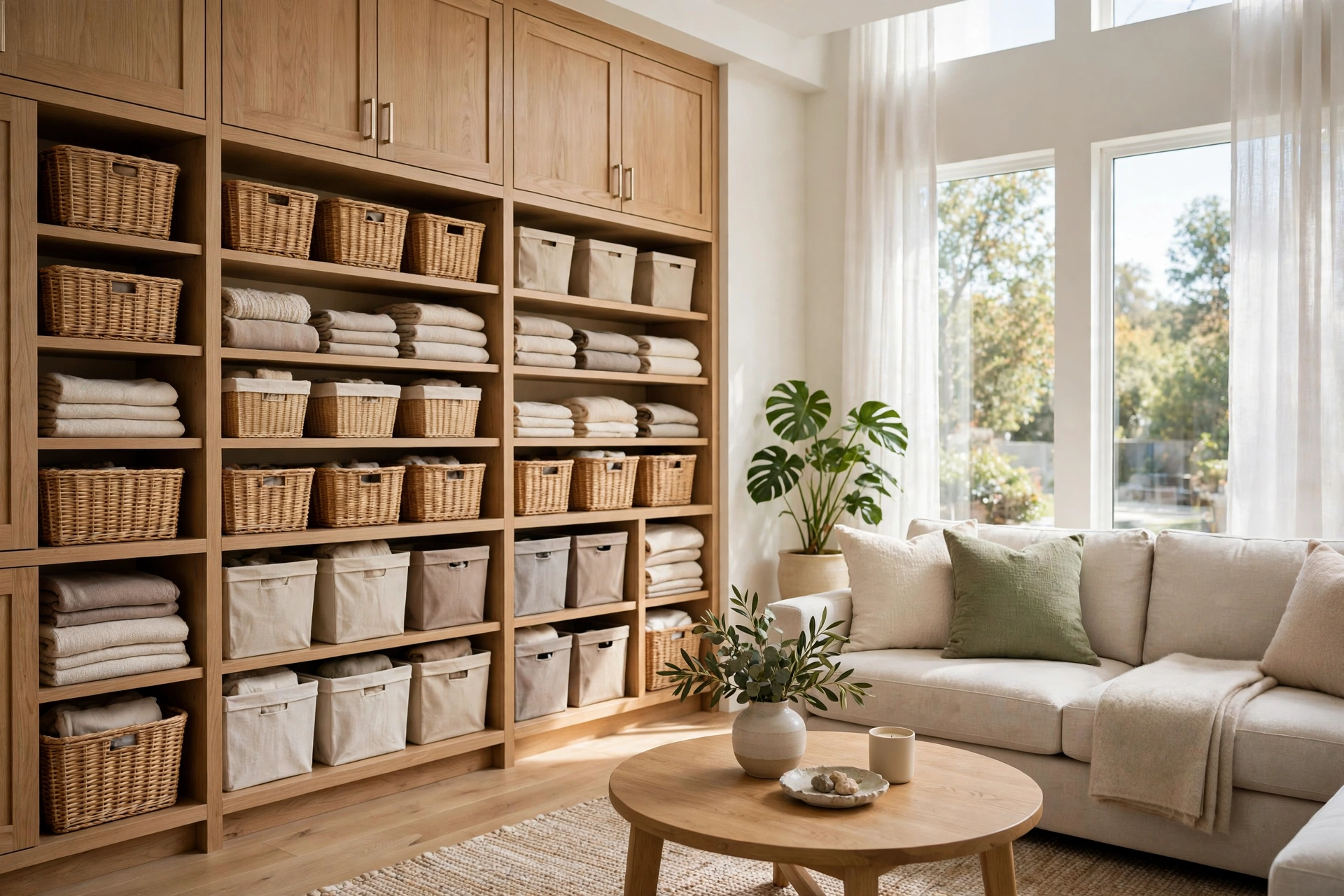
Beauty and organization are linked by one idea: visual quiet. A room feels cluttered not only when it holds too much, but when the eye has nowhere to rest. Three techniques calm a whole house quickly. First, decant and unify: move pantry goods into matching clear containers and switch closet hangers to a single style. Second, clear the flat surfaces: keep counters, tables, and vanities mostly empty, with only daily essentials on display, grouped on a tray. Third, leave breathing room on purpose: fill shelves and containers to roughly eighty percent of their capacity and leave a small gap between baskets.
One Home, Many Routines: Daily Resets That Keep Every Room in Step
No organization system survives without maintenance, and whole-home systems survive on small, shared routines rather than heroic weekend sessions. The most effective is the ten-minute evening reset: every evening, each household member returns items to their homes, clears the day’s flat surfaces, and stages tomorrow’s bags and keys at the entry. A weekly reset, perhaps thirty minutes on a weekend, handles the jobs daily resets miss: fridge and pantry check, laundry put away completely, and entryway emptied of outgrown items.
- Morning: make beds, clear breakfast surfaces, and return overnight items to their zones.
- Evening: ten-minute reset, with flat surfaces clear and tomorrow’s bags and keys staged.
- Weekly: thirty-minute reset, with laundry put away and the fridge checked.
- Seasonal: one session per season for outgrown clothes and expired goods.
Where Whole-Home Organization Trips Up Even Motivated Households
Even motivated households stall in predictable places. The first trap is organizing before editing: buying beautiful bins and then discovering the house still holds too much to fit them. Edit first, always, and let the remaining quantity dictate the storage you buy. The second trap is perfectionism: waiting for a free weekend to do the whole house at once, then never starting. Fifteen focused minutes a day, sustained for a month, beats a single exhausting weekend that ends half-finished. The third trap is designing for an imaginary household instead of the real one. If mail always lands on the kitchen counter despite a filing cabinet in the office, the mail station belongs near the kitchen counter.
What a Whole-Home Organization Budget Really Looks Like, in Estimates
Whole-home organization can cost almost nothing or several thousand dollars, depending on how much help you hire and how much storage you buy. A do-it-yourself project using boxes you already own, a label maker, and a modest set of matching bins typically runs in the low hundreds of dollars in total. Published 2026 guides put typical organizer hourly rates at roughly $50 to $150 per hour, and whole-home projects commonly quoted at roughly $2,000 to $5,000 or more. These are broad estimates, not quotes.
When Bringing in a Professional Organizer Makes Sense for a Whole House
Most homes can be organized without professional help, given time and a workable plan. There are situations, however, where outside help pays for itself. If you have tried to organize several times and the house keeps reverting, an organizer brings objectivity and a system designed for your habits. If you are moving, downsizing, or settling an estate, a professional can set up systems from day one. If clutter is affecting daily life, for example lost documents or missed bills, that is a sign the problem has outgrown a weekend project.
Safety deserves a mention in any whole-home project. Heavy items belong low and stable, never stacked above head height. Wall-mounted shelving must be fixed into studs or proper wall anchors, not held by plaster alone. Keep papers away from heaters and stoves, avoid overloading power strips in a charging zone, and never block exits, stairways, or heating vents with stored items.
A Whole-Home Zone Map You Can Copy for Your Own House
The table below turns this article into a single plan you can adapt. Walk your home with it and start with the weakest zone.
Whole-Home Organization Questions Homeowners Ask Before Starting
How Long Does Organizing a Whole House Realistically Take?
It depends on home size and how much you own, but a realistic pace is one focused category at a time over several weeks, not a single weekend. Many households spend fifteen to thirty minutes a day for a month to work through a whole house.
Should I Declutter the Whole House Before Buying Any Storage?
Yes, in almost every case. Storage bought before editing usually ends up holding things you do not need, and it hides the real quantity you own. Sort by category first, decide what stays, and only then buy containers to fit what remains.
How Do I Keep a Clutter-Free Home With Children or Shared Housemates?
Give every person their own clearly labelled zone, basket, or shelf within shared spaces, and keep the shared rules short: everything has one home, and the evening reset is a household habit, not one person’s job. Children maintain systems they can reach and understand, so keep their storage low, visual, and simple.
What Is the One-In, One-Out Rule, and Does It Really Work?
The rule is simple: for every new item that enters the home, one old item leaves. It works because it caps the total quantity, which is the real driver of clutter. Apply it house-wide to clothes, toys, gadgets, and kitchenware, and let the outgoing item leave immediately, into a donation bag by the door.
Can a Small Home or Apartment Look Clutter-Free Without More Space?
Yes, and small homes often benefit most from whole-home techniques, because every item matters more. Use vertical space with wall shelves and door hooks, choose furniture with built-in storage, keep flat surfaces clear, and be stricter about duplicates and rarely used items.
How Do I Organize Sentimental Items Without Throwing Memories Away?
You do not have to throw memories away. Give sentimental items a clear boundary instead: one labelled keepsake box per person, stored in a single place, and digitize photographs and children’s artwork where possible.
Is Hiring a Professional Organizer Worth the Cost for a Whole House?
It can be, particularly for moves, downsizing, or homes where repeated attempts have stalled. Typical 2026 pricing guides put hourly rates at roughly $50 to $150 per hour and whole-home projects at roughly $2,000 to $5,000 or more. Always get a written estimate first.
The Beautiful Home Is the One You Can Actually Live In
A clutter-free, beautiful home is not a home without personality. It is a home where the things you love are visible, the things you use are reachable, and everything else has quietly left. Start with the walk-through, sort by category, and give every category one home.