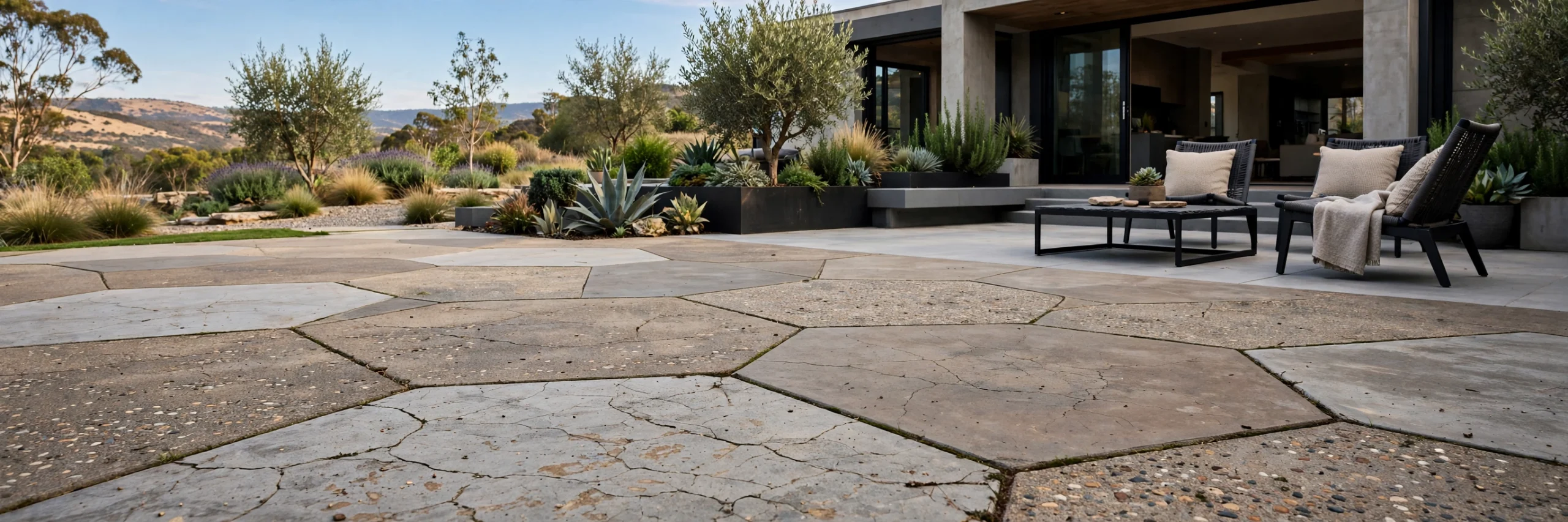
A patio floor does more visual work than almost anything else in a backyard. Furniture comes and goes, but the surface underfoot sets the tone every single day. A plain grey slab makes even good furniture look temporary, while a floor with colour, texture, and a deliberate pattern makes the whole space feel finished.
The short answer: decorative concrete gives most homeowners the widest creative range for the money, because one material can be stamped, stained, polished, or seeded with aggregate to imitate stone, brick, or timber. Porcelain suits crisp contemporary schemes, stone suits gardens that should age softly, and permeable pavers suit yards where drainage matters. Climate, sun exposure, and drainage matter more than which material photographs best.
Stamped Concrete That Reads as Stone, Brick, or Timber Without Their Price Tags
Stamped concrete is the workhorse of creative patio flooring. While a fresh slab is still workable, large polyurethane mats are pressed into the surface to imprint patterns that mimic ashlar slate, flagstone, cobblestone, running-bond brick, or timber planks. A colour hardener or integral pigment sets the base tone, and a contrasting release agent settles into the low points, giving each imprinted joint a shadowed, stone-like depth. From ten feet away, a well-executed stamped flagstone patio is genuinely hard to tell from real flagstone.
The creative freedom comes from combining pattern, colour, and layout: a single slate field framed with a brick-pattern border, or a circular medallion marking the dining zone while the rest stays quiet. Stamped concrete is still a single slab, so control joints must be planned to disappear into the pattern lines, and resealing every two to three years keeps it from looking tired. Installed costs typically run $12 to $25 per square foot, with borders and multi-colour work at the top of that range.
Stained and Polished Concrete: Mottled Colour and a Contemporary Sheen
Where stamping imitates another material, staining celebrates concrete itself. Acid-based stains react chemically with the minerals in the slab, producing variegated, marbled colour that can never be repeated exactly — no two stained patios are identical. Water-based stains and dyes deposit colour more evenly and offer a broader palette, from warm terracotta and sandstone to charcoal and slate blue. Either approach can refresh an existing slab.
Polished concrete takes a different route to the same contemporary goal: grinding the surface progressively finer, then densifying and sealing it, produces a smooth, light-reflecting floor for outdoor kitchens and modern extensions. Outdoors, gloss is softened to matte or satin so the surface stays safe when wet. Colour choice matters here too — dark stains absorb heat and can turn a sunny patio uncomfortable barefoot by mid-afternoon, while lighter tones reflect more heat but show leaf stains sooner.
Exposed Aggregate: Pebble Texture That Grips Bare Feet and Wet Shoes
Exposed aggregate is the most naturally slip-resistant decorative concrete finish, which is why it appears so often around pools and on sloped patios. After the pour, a surface retarder slows the setting of the top layer of cement paste, which is then washed away to reveal the decorative stones inside the mix. River pebbles give a soft, rounded look, crushed granite gives sparkle, and glass aggregate adds flashes of colour.
Because the texture is built in rather than painted on, it does not wear away like a coating. The trade-off is comfort: bare feet notice the texture, and furniture legs can rock on a heavily exposed finish. Choose a finer aggregate and lighter exposure for dining areas, reserving deep exposure for paths and pool surrounds, and seal the surface to hold stones in place and make stains easier to wash off.
Porcelain Pavers: Crisp, Large-Format Surfaces That Barely Age
Outdoor porcelain pavers are the contemporary answer to patio flooring. At around 20 millimetres thick — roughly three-quarters of an inch — they are far chunkier than indoor tile, which lets them be dry-laid on aggregate or carried on pedestals over a slab or roof deck. Their water absorption sits below half a percent, so almost no moisture inside the slab can freeze and expand, making them genuinely frost-proof and colour-stable in strong sun.
The design appeal is precision: large-format slabs in concrete grey, crisp white, or wood-look planks create clean, uninterrupted planes, and because colour runs through the body of a full-bodied slab, a chipped edge is far less obvious than on glazed tile. There is no sealing to schedule and no fading to chase. Drawbacks are weight — a 24 by 48 inch paver is a two-person lift — costly cutting around curves, and heat on dark colours, so choose a matte or lightly textured face.
Natural Stone Flags: Travertine, Bluestone, and Sandstone Patina
Natural stone brings something no manufactured product can fully copy: genuine variation. Every flag is unique, and the surface ages into a soft patina rather than staying factory-perfect. Travertine stays relatively cool underfoot and suits pool patios, bluestone offers a dense, blue-grey contemporary surface, and sandstone delivers warm, riven texture that sits comfortably against brick and older houses.
Stone asks for more care in return. Most stones are porous, so they need sealing when clean and dry and resealing every few years; softer stones stain if a spill sits, and marble etches on contact with acids. The delivered pallet will differ from the showroom sample, so inspect it and blend flags from several pallets as you lay. If you want a uniform floor, porcelain will frustrate you less.
Concrete Pavers and Permeable Joints: A Floor That Lets Rain Through
Concrete pavers offer a middle path between a poured slab and loose stone. Individual units in dozens of colours and profiles can be laid in herringbone, basketweave, or running bond, and because each unit moves independently, a damaged paver can be lifted and replaced without touching the rest of the patio. That repairability is a genuine long-term advantage over any monolithic slab.
Permeable pavers go one step further by turning the joints into drainage. Wider joints filled with small, highly permeable aggregate let rainwater pass into a crushed-stone reservoir below, instead of sheeting toward the lawn or the house. They suit low spots and heavy clay soil — but they are a system, and clogged joints must be cleaned to stay permeable.
Mixing Materials: Borders, Inlays, and Rug-Effect Layouts That Anchor a Patio
The most interesting patio floors rarely use one material alone. A stamped concrete field with a natural stone border, a porcelain dining pad set inside a gravel court, or a brick inlay marking the path from the back door each give the eye something to follow and make a large patio feel designed rather than poured.
A rug-effect layout is the simplest mixed-material trick. Lay a contrasting rectangle — porcelain planks, brick, or a different concrete colour — exactly where the dining table or seating group will sit, and let the surrounding field stay quieter. The contrast anchors the furniture visually. Keep the palette tight: two materials plus one accent colour is usually enough.
Choosing by Climate, Sun, and Slope: The Drainage Rules Under Every Pretty Floor
Every beautiful patio floor fails if water has nowhere to go. The universal rule is a slope away from the house of roughly one-eighth to one-quarter inch per foot — about one to two percent — so a ten-foot-deep patio drops roughly one and a quarter to two and a half inches from the house to its outer edge. Flat spots collect water, breed algae, and invite freeze-thaw damage, while a slope toward the house sends water straight at the foundation.
Climate narrows the shortlist fast. Freeze-thaw regions favour frost-proof porcelain and well-drained paver bases and punish unsealed porous stone. Hot regions favour light colours and cool travertine. Wet climates favour textured finishes, permeable joints, and a defined outlet such as a channel drain.
- Slope check: a four-foot level and a tape measure show whether a slab falls away from the house.
Patio Flooring Choices at a Glance
The table below compares the main patio surfaces on appearance, installed cost, and care. All costs are broad estimates for professional installation and vary by region and site preparation.
A Weekend-Smart Sequence for Planning a New Patio Floor
Keep decisions in the right order, so you are not choosing a pattern before you know whether the ground beneath it will drain.
- Measure the space and mark furniture zones, leaving three feet clear around a dining table.
- Map sun, shade, and water: afternoon sun, pooling spots, and downspout discharge points.
- Pick the material family first — concrete, pavers, or stone — then the pattern and colour.
- Order full-size samples and live with them on site for a week, checking colour wet and dry.
- Confirm the base and slope specification in writing: base depth, compaction, and fall away from the house.
- Book the first sealing before the crew leaves.
Patio Floor Slip-Ups That Show Up After the First Rain
Most patio flooring regrets are not about taste; they are about skipped details. The commonest is a slab poured dead level, which looks perfect on a dry day and holds a shallow lake after the first storm. Almost as common is indoor tile used outdoors, which cracks in the first freeze and turns treacherous when wet.
Colour and sealer mistakes show up more slowly: a dark stain chosen from a tiny chip can turn a sunny patio into a heat trap, and a glossy sealer over a smooth finish can make a wet patio slick. Skipping edge restraint lets outer pavers creep outward within a season, opening joints and inviting weeds. Each is cheap to prevent and expensive to fix.
What Patio Flooring Work Belongs With a Contractor, Not a DIY Pour
Small refreshes — staining a sound slab, laying interlocking tiles over concrete, or re-sanding joints — are realistic weekend projects. A new pour is different: concrete arrives all at once, stamping must happen in a narrow window before initial set, and there is no undo if the slope or pattern goes wrong.
Bring in a contractor when the patio is large, drainage must be regraded, the slab meets a pool coping or retaining wall, or mixed materials of different thicknesses must finish flush. Ask for recent local projects you can walk on and a written specification for base depth, slope, and sealing.
Patio Flooring Questions Homeowners Ask Before Ordering Materials
Can decorative concrete really look like natural stone?
Yes, when done well. Stamping imprints the texture and joint pattern of slate or flagstone, and a two-tone colour process creates the shadowing that sells the illusion. From standing distance a good stamped patio is convincing, at roughly half the cost of real stone.
How long does a decorative concrete patio last?
A properly built concrete patio commonly lasts thirty years or more, maintained by periodic resealing. The slab is the long-life component; what ages visibly is sealer and colour, which is why the resealing schedule matters more than the pattern.
Is porcelain too slippery for a patio?
Not if you choose an outdoor-rated paver with a textured or matte face. Smooth, glossy porcelain is the risky choice — outdoor pavers are thicker, frost-proof, and sold with slip-resistance ratings. Walk a wet sample before ordering.
Do I need a permit for a new patio floor?
Usually not for a ground-level patio, but rules vary by municipality, especially near property lines, over easements, or where stormwater limits apply. A quick call to your building department beforehand is cheaper than a stop-work order halfway through.
Can I lay a new patio floor over my old concrete slab?
Often, yes. Porcelain pavers on pedestals, interlocking tiles, and thin overlays can all sit over a sound slab, provided it is stable, drains correctly, and has no major cracking. A slab that sinks or drains toward the house should be repaired first, not covered up.
What is the lowest-maintenance patio flooring?
Outdoor porcelain pavers, followed by well-sealed concrete pavers. Porcelain needs no sealing and resists stains, moss, and fading, so care is mostly sweeping and an occasional wash. Stone and stamped concrete both ask for a resealing routine.
The Patio Floor That Still Looks Intentional in Ten Years
The patios that age best are rarely the most elaborate. They are the ones where the material suits the climate, the slope sends water away from the house, and the owner knew the maintenance routine before the crew left. Choose concrete for range, porcelain for low maintenance, stone for character, or pavers for repairability — and let the ground beneath the floor carry the decision.